There is a special kind of sentence that service businesses learn to fear.
It usually starts with:
'Can you just…'
Can you just make it pop?
Can you just send a quick quote?
Can you just build something simple?
Can you just do what our competitor has, but different, cheaper, better, faster, and ideally by Thursday because the moon is in admin panic?
Every business owner who sells a service knows this dance.
A client says one thing.
They mean another thing.
They are worried about a third thing.
And somehow you are expected to decode all of that while drinking cold coffee, answering emails, quoting three jobs, replying to a Facebook message from someone who thinks 'budget' is a personality disorder, and wondering whether your website is quietly leaking money like a haunted bucket.
So for Day 13 of the 30-day build challenge, I built a tool for that exact moment.
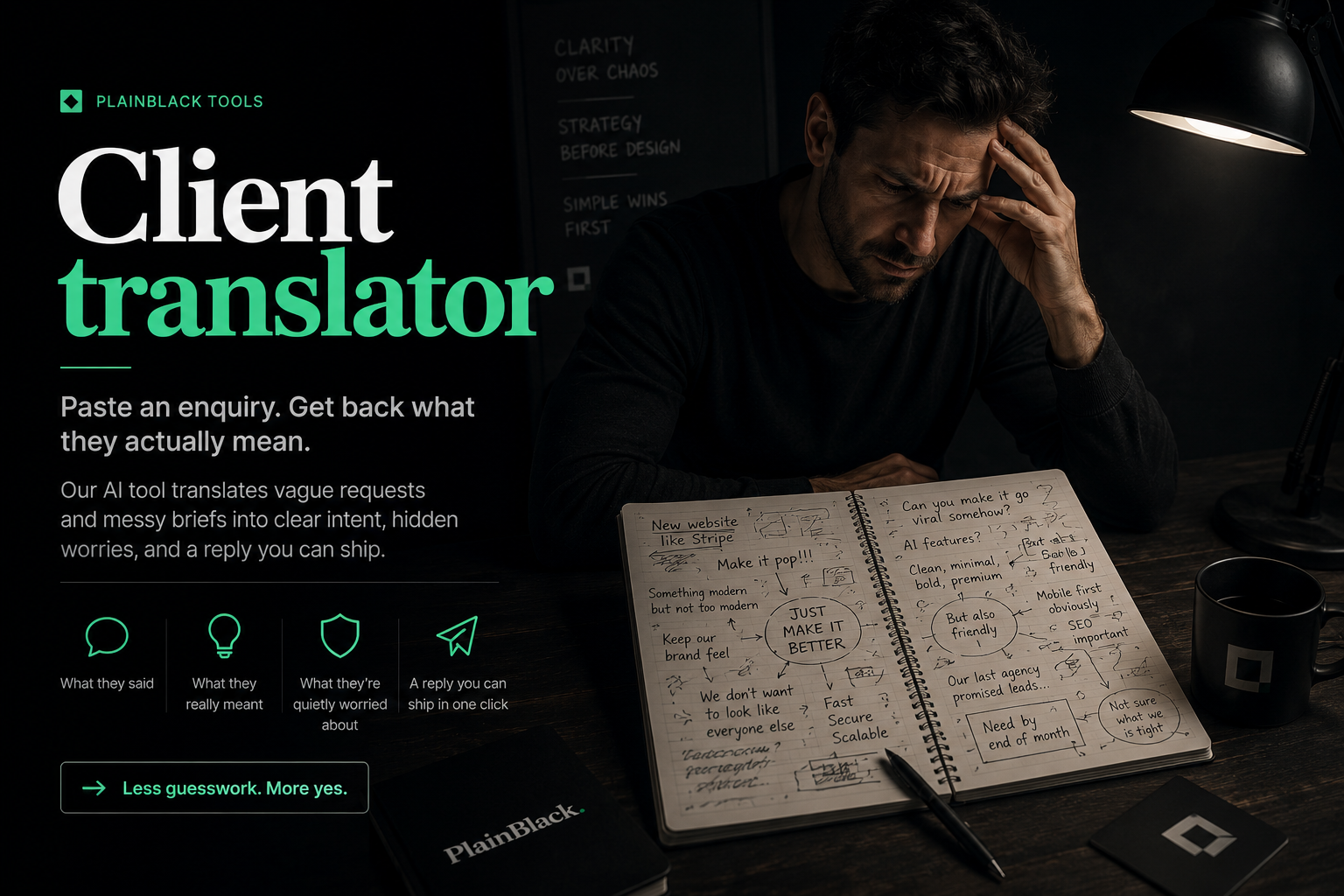
It is called Client Translator.
Paste in a real enquiry.
It gives you back four things:
What they said.
The plain version of the message.
What they really meant.
The actual intent hiding underneath the words.
What they are quietly worried about.
The fear, hesitation, or risk they probably have not said out loud.
A reply you can ship.
A clear, useful response you can send without staring at the screen until your soul leaves through the keyboard.
Because here is the uncomfortable truth.
Most client communication problems are not really communication problems.
They are translation problems.
Clients rarely ask for what they actually need
This is not because clients are stupid.
They are not.
They are busy, uncertain, half-informed, and usually trying to explain a problem using whatever language they have available.
That is different.
A cafe owner might say:
'We need a better Instagram.'
But what they probably mean is:
'We need more people remembering we exist before they choose the place down the road.'
A roofer might say:
'We need more leads.'
But what they may actually mean is:
'We need fewer time-wasters and more people who already understand the value of doing the job properly.'
A consultant might say:
'Our website feels outdated.'
But the real issue could be:
'Our offer has changed, our positioning is muddy, and the website is now wearing someone else's trousers.'
Not ideal. Nobody wants a website in borrowed pants.
The point is, the enquiry is rarely the whole story.
It is the first clue.
And most service providers already know this instinctively. You learn it by getting burned.
You learn that 'simple website' can mean anything from a one-page brochure site to a fully integrated booking platform with custom forms, automation, CRM logic, SEO, copywriting, brand strategy, and a client who still thinks it should cost about the same as a toaster.
You learn that 'quick logo' often means 'I have not worked out who this business is for, what it should be known for, or why anyone should care yet.'
You learn that 'we just need some content' usually means 'we have no idea what to say, who we are saying it to, or what action we want people to take.'
That is not a client problem.
That is a clarity problem.
And clarity is where the money usually lives.
Every service provider already puts words in their client's head
Let's be honest.
Every decent service business already does some version of this.
You read between the lines.
You hear what they said, then quietly translate it into what they probably meant.
You spot the panic hiding inside the polite request.
You notice the difference between a serious buyer and someone collecting quotes like Pokémon cards.
You know when 'just exploring options' means 'I am not ready.'
You know when 'we had a bad experience with our last person' means 'please do not make me feel stupid for trusting the wrong agency.'
You know when 'can you send pricing?' means 'I am trying to work out whether this is safe before I give you any more of my time.'
The good ones do this carefully.
The bad ones weaponise it.
That is where marketing and sales can get filthy pretty quickly.
There is a big difference between understanding what someone means and shoving your own agenda into their mouth like a cursed ventriloquist.
Client Translator is not built to manipulate people.
It is built to slow the moment down and help a business owner respond with more care, more clarity, and less guesswork.
It does not say, 'Here is how to close them at all costs.'
It says, 'Here is what might actually be going on. Now reply like a useful adult.'
A shocking concept. We expect the sales industry to recover by 2047.
Why this matters for small business owners
Most small business owners do not lose opportunities because they are bad at their craft.
They lose them in the messy middle.
The enquiry comes in.
The client is vague.
The business owner is busy.
The reply is rushed.
The scope is assumed.
The quote goes out too early.
The client disappears.
Then everyone shrugs and blames price.
But price is not always the real reason people ghost.
Sometimes they did not feel understood.
Sometimes the reply answered the literal question but missed the actual concern.
Sometimes the client was trying to say, 'I do not know how this works and I need you to guide me,' but the business sent back a number and hoped for the best.
That is how good-fit work slips through the cracks.
Not dramatically.
Quietly.
Like a tiny admin goblin dragging revenue into the walls.
Client Translator helps stop that.
It gives the business owner a better first read of the enquiry, so they can respond like someone who sees the person behind the request.
And for service businesses, that is not fluffy.
That is commercial.
Because the first reply often decides the shape of the whole job.
A vague reply creates a vague job.
A rushed reply creates a rushed job.
A clear reply creates a better conversation.
And a better conversation gives you a fighting chance of quoting properly, scoping properly, and avoiding the slow horror of 'while you're there' work.
What the tool actually does
The tool is simple on purpose.
Paste a real client enquiry into the box.
The tool gives you four cards.
The first card shows what the client literally said.
The second card translates what they probably mean.
The third card identifies what they may be quietly worried about.
The fourth card gives you a reply you can send, edit, or steal like a raccoon with invoice software.
Actually, we are apparently retiring raccoon references. Internal brand governance has spoken. A small woodland creature has been made redundant. Very sad.
Anyway.
The point is that the tool is not trying to replace your judgement.
It is trying to give you a sharper starting point.
It helps you notice:
- when someone is asking for a thing but really needs a strategy
- when someone is worried about cost but actually scared of wasting money again
- when someone wants speed but still needs guidance
- when someone is vague because they do not know the right language yet
- when someone sounds difficult but might just be anxious
- when someone sounds easy but is actually walking scope creep in human form
That last one matters.
A lot.
Some enquiries look harmless at first.
Then a short back-and-forth later you are building a Frankenstein project out of assumptions, favours, unpaid consulting, and the phrase 'just one more small change.'
This tool is a little early-warning system.
Not perfect.
But useful.
And useful beats impressive most days of the week.
The quiet pain this solves
This whole challenge has forced us to keep asking the same question:
What is the quiet pain a small business owner lives with?
Not the obvious one.
The quiet one.
The one they do not write on a contact form.
For this tool, the quiet pain is this:
Small business owners are expected to understand what clients mean before the client knows how to explain it.
That is a lot.
Especially when the owner is already doing the work, quoting the work, chasing the work, delivering the work, fixing the printer, updating the website, and pretending they are going to post consistently on social media this week.
Which brings me neatly to Ian.
Ian is meant to be doing daily videos for this challenge.
In fairness, he has done some.
In unfairness, which is where most good jokes live, I have now built thirteen tools in a garage while Ian has been engaging in what I can only describe as 'video-adjacent leadership.'
He has big video energy.
The videos themselves are arriving with the punctuality of a regional bus service operated by possums.
Still, we love him.
And to his credit, when the video does appear, it usually explains the idea in a way that makes people go, 'Oh. That actually makes sense.'
Eventually.
Probably.
No pressure, Ian.
Why this is a PlainBlack kind of tool
A normal agency would probably turn this into a lead magnet called:
'Unlock Client Communication Excellence With Our Proven Conversion Framework.'
Which is nine words too many and somehow still says nothing.
We built a translator.
Because that is the actual job.
Take the messy thing someone said.
Work out what matters.
Find the fear underneath it.
Reply clearly.
That is the move.
It is not a quiz.
It is not a 47-page workbook.
It is not a webinar funnel wearing a helpful moustache.
It is a practical tool for the moment a real business owner actually has:
A message comes in.
They need to reply.
They want the reply to be useful.
They do not want to spend long mentally spelunking through a stranger's emotional subtext while dinner gets cold.
Client Translator gives them the useful bits, circled.
That is what good AI should do.
Not replace the human.
Not vomit generic content into the void.
Just help the human make a better decision faster.
The bigger lesson from Day 13
The longer we do this challenge, the clearer something becomes.
The best tools are not always the biggest tools.
They are the tools that sit inside tiny, annoying moments and remove friction.
That is where small businesses actually live.
Not in strategy documents.
Not in funnels.
Not in dashboards that look impressive until someone asks what the numbers mean.
They live in the reply they have to send before school pickup.
The quote they need to finish tonight.
The customer message they are not sure how to handle.
The awkward enquiry that could be a great job or a bin fire wearing shoes.
That is where better marketing starts.
In the real moment.
With the real person.
Solving the real stuck point.
Client Translator is Day 13 because this challenge is not just about building shiny things.
It is about building useful things.
Tools that protect time.
Tools that create clarity.
Tools that help small business owners stop guessing what to do next.
And yes, tools that quietly prove PlainBlack thinks about marketing a bit differently.
Because if all we do is build the same calculators, audits, and generic AI sludge everyone else is building, we may as well pack it up and go sell motivational PDFs to LinkedIn men in quarter-zips.
Nobody needs that.
The internet is already full.
Try the Client Translator
Paste in a real enquiry.
See what they said.
See what they probably meant.
See what they are worried about.
Then send a better reply.
Less guessing.
Fewer weird assumptions.
More useful conversations.
And possibly fewer jobs that begin with 'can you just' and end with you staring into the middle distance like a Victorian ghost.
Which, frankly, feels like progress.