Most AI content sounds like it was written by a very polite fridge.
Technically correct. Structurally tidy. Emotionally dead.
You ask it for a blog post and it gives you something with phrases like "in today's fast-paced digital landscape," which is how you know nobody involved should be trusted near your marketing.
So today we built something better. Not a generic AI writer. Not another content tool that promises to "unlock your brand voice" before producing the same beige pudding as every other tool. A blog generator trained on how PlainBlack actually sounds.
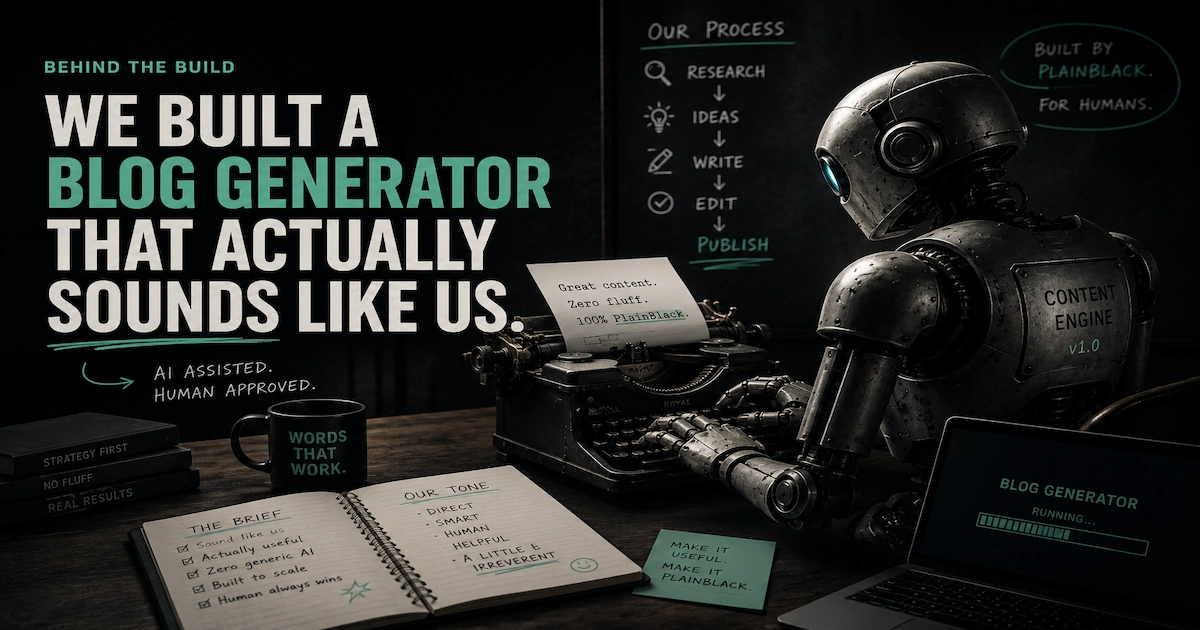
Why we built it
We are in the middle of a 30-day build challenge. Every day Jayden builds something useful. Every day there is a blog explaining what we built, why it matters, and how it could help a real business owner. Plus a Facebook post. Plus a LinkedIn post. Plus image prompts. Plus alt text. Plus tags.
The build was not the bottleneck. The content was.
Which is deeply annoying, because we are a marketing studio. Being slowed down by content is like a mechanic being defeated by a spanner. Not ideal. Not spiritually nourishing.
By the end of week one the math was obvious. If we kept hand-writing every blog, every Facebook post, every LinkedIn post, every image prompt, every excerpt, every tag, the challenge would quietly collapse into the same graveyard as most content plans. The place where "we should post more" goes to die.
So we built the missing piece. A tool that turns one clear idea into a finished content pack.
The actual problem this solves
Most small business owners do not have an idea problem. They have an execution problem.
You know you should publish. You know the website should look alive. You know Google probably prefers businesses that did not visibly vanish in 2021. But then work happens. Customers call. Quotes need sending. Someone has to chase invoices. A staff member asks where the thing is, despite the thing being exactly where the thing always is.
Then marketing gets pushed to night-time. And night-time marketing is where good intentions go to get murdered by exhaustion.
That is why most content systems fail. Not because the owner is lazy. Not because the business is boring. Not because they need a 14-part content pillar strategy from someone wearing a headset microphone. They fail because the system asks too much.
You need the idea. Then the draft. Then the edit. Then the image. Then the caption. Then the post. Then the upload. Then the tags. Then the meta description. Then the social version. Then the "I'll do it tomorrow" lie.
Our blog generator compresses that whole mess. One topic in. A full content pack out.
The important bit: it actually sounds like us
This is where most AI tools fall over and make that sad little Windows error noise in your soul. They are fast, yes. But fast generic content is still generic content, and generic content does not build trust. It just fills space. Useful if you are decorating a waiting room. Less useful if you are trying to win customers.
We trained ours on our actual voice. That means it knows PlainBlack is direct, useful, slightly allergic to jargon, protective of small business owners, happy to call bullshit when bullshit wanders into the room wearing a name badge, and focused on making marketing make sense.
It also knows what we do not say.
No "unlock your potential." No "take your business to the next level." No "in today's competitive marketplace." No "drop your thoughts in the comments." No content that sounds like it was assembled in a webinar funnel by someone named Chad.
That matters because voice is not decoration. Voice is trust. If someone reads your blog, then your website, then your social posts, and every piece sounds like a different unpaid intern wrote it during a mild crisis, your brand feels weaker than it should. A good content system should make you more consistent. Not more robotic.
What it creates
The tool takes one topic and turns it into the useful pieces we actually need.
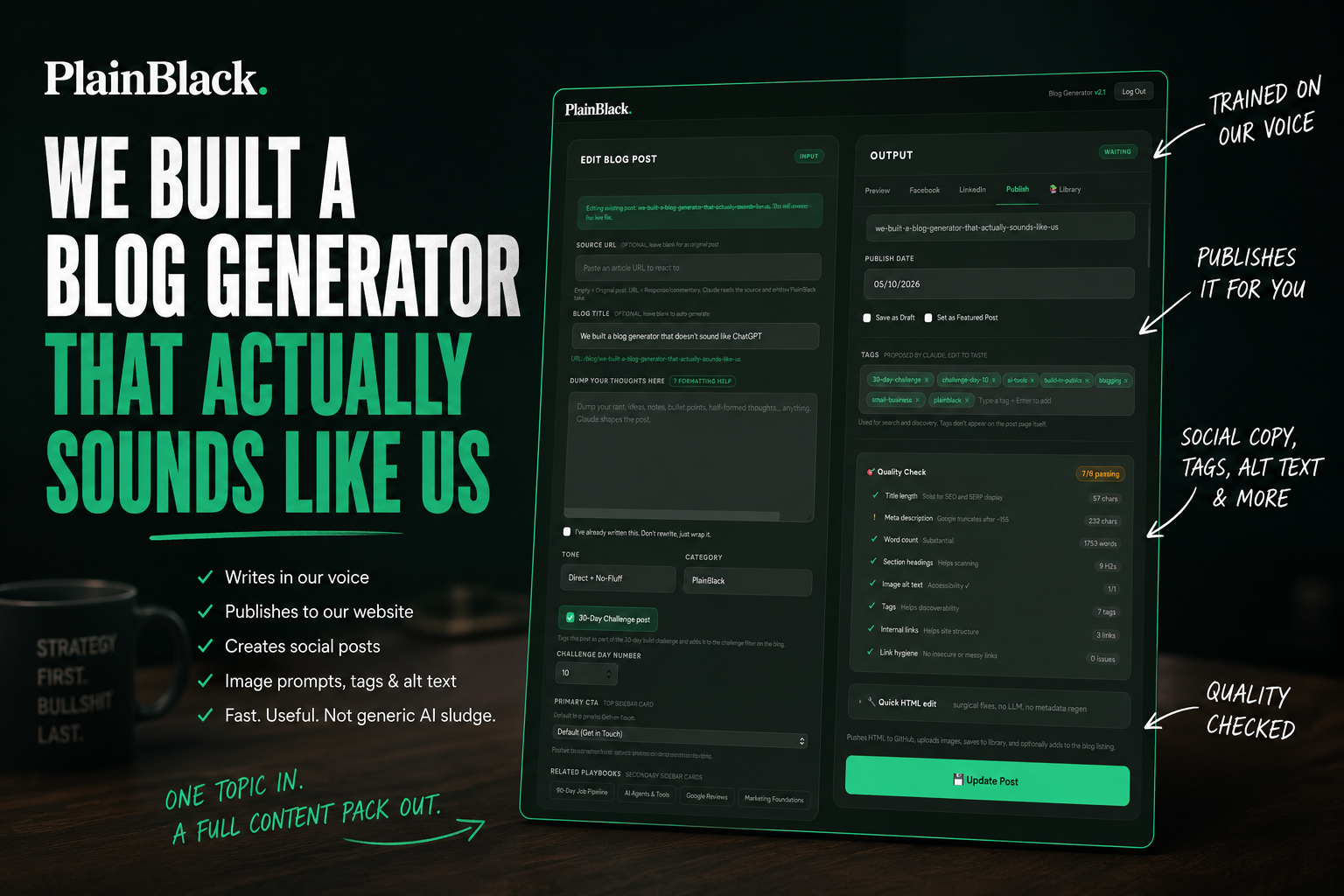
1. A blog post. Not a loose AI draft that still needs three hours of emotional repair. A structured post written in our style, ready to review and publish. Clear thinking. Sharp voice. Obvious point. The goal is not to "produce content"; the goal is to explain something useful in a way the right person understands. Tiny distinction. Massive difference.
2. Website publishing. The post does not just sit in a Google Doc like a sad little orphan. The tool publishes it. Drafts can stay hidden. Published posts go live. Archived posts come off the blog without breaking old links. Deleted posts can be recovered. Most content systems die in the gap between "written" and "actually live on the website." That gap is where momentum gets eaten by admin.
3. Facebook and LinkedIn copy. A blog is not finished when the blog is published. It still needs to be shared. The tool writes platform-specific social copy. Facebook gets the casual, observational version. LinkedIn gets the sharper, insight-led version. They are not the same post with a different hat on, because that is not a content strategy, that is copying your homework and changing the font.
4. Image prompts. Every post needs visuals. The generator creates image prompts that match the article. That gives us a faster way to brief hero images without starting from "make it look cool," which is the official prayer of people about to receive AI slop. Most content stalls at the visual: the post is written, then someone needs a photo, then nobody has one, then Canva opens, then 48 minutes disappear, then the final image looks like a real estate flyer had a panic attack. This skips that mess.
5. Alt text, tags, and the boring bits that still matter. Not glamorous. Still useful. Good publishing is not just writing words and hoping the internet claps. The post needs to be findable, organised, shareable, and accessible. That is the boring plumbing under content. Nobody wants to think about it. Which is exactly why the tool does it.
Why "trained on your voice" is the bit that matters
Any AI tool can write a blog. That is not special anymore.
The special part is whether it can write something that sounds like you, speaks to your customers, and supports your business instead of producing generic internet mulch.
A dog groomer should not sound like a law firm. A plumber should not sound like a SaaS company. A local cafe should not sound like a corporate wellness retreat. A roofing company should not sound like it hired a LinkedIn ghostwriter who says "value proposition" in casual conversation.
For your content to feel like your business, the tool has to actually know:
- what you sell and who you sell to
- how your customers talk and what they care about
- what questions they ask before buying
- what makes you different
- what tone feels natural for your brand
- and crucially, what you would never say
That is why we trained ours properly. The AI is the engine. The voice rules are the steering wheel. Without the steering wheel, you are just letting a robot drive your brand into a hedge.
Who this is useful for
This kind of tool makes sense if you:
- know you should publish more, but do not have time
- have a website that rarely gets updated
- want content that sounds like your business
- are tired of generic AI content
- need social posts but hate starting from scratch
- want to turn real jobs, offers, and customer questions into marketing
It is probably not for you if you want to become a full-time content creator. Different illness.
This is for business owners who want marketing to become lighter, clearer, and more consistent. Roofers. Cafes. Accountants. Allied health clinics. Tourism operators. Mechanics. Dog groomers. Consultants. Small teams doing real work and trying to stay visible without feeding the content machine their entire life.
The uncomfortable truth
Most small businesses do not need more marketing advice. They need fewer moving parts. They need a system that helps them do the useful thing more often.
That is what we built. Not a content toy. Not a prompt pack. Not a course pretending to be help. A working blog generator that takes an idea, writes in our voice, publishes to our site, gives us social copy, creates image prompts, handles the boring bits, and gets us moving faster.
And yes, this post came through it. Which feels slightly smug to say, but at least it did not write "in today's digital landscape," so we are counting that as civilisation holding the line.
Day 10 of 30. Twenty days to go.
Try it yourself. Read the two posts the tool wrote today. Decide if they sound like us, or like a content marketer doing a value-add post.