Namecheap says blogging still works.
Which is convenient, because Namecheap sells the thing you need to start a blog.
That does not make them wrong. It just means we should maybe read the article with one eyebrow raised, because basic pattern recognition remains legal in most parts of the internet.
Their argument is simple enough: blogs still matter because people read them, the format works, personality cuts through, blogs keep evolving, and niche audiences still exist.
On paper, that sounds reasonable. In the real world, the question is messier.
Does blogging still work for a normal small business in 2026? Not a media company. Not a celebrity founder. Not a SaaS business with a content team, a budget, and someone called "Head of Organic Growth" gently ruining meetings. A real small business. The kind with actual work to do, invoices to chase, customers to call, and a website that has not seen fresh content since the Queen was alive.
That is the question we care about. So we are testing it.
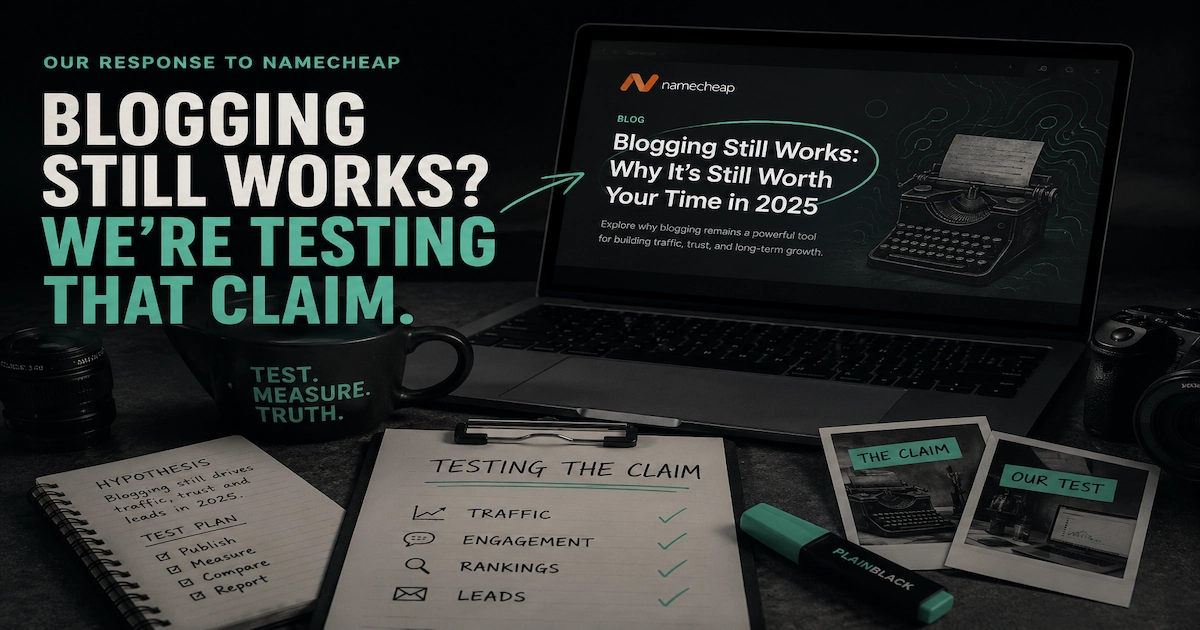
The theory sounds good. That is not the same as proof.
Namecheap's post makes five main points. Blogging is still big. The format is still useful. Personality still matters. Blogs keep evolving. Niches still create opportunity.
None of that is ridiculous.
The problem is that "blogging still works" is one of those sentences that sounds helpful until you try to use it.
Works how? For traffic? For trust? For Google? For AI search? For local visibility? For sales? For proving you are not one of those businesses with a dead website and a contact form that may or may not go to an inbox last opened in 2019?
Because those are different jobs.
And this is where small businesses get stitched up. They hear "blogging works," so they start a blog. Then they write three posts:
- "Welcome to our new website"
- "Why choose us"
- "Five reasons to maintain your gutters before winter"
Then nothing happens immediately, because the internet is not a vending machine. So they stop. Then six months later some marketing person tells them they need "content," and the cycle begins again, like a cursed merry-go-round powered by vague advice and mild shame.
We are not asking whether blogs exist. We are asking whether they move anything.
The internet does not need more proof that blogs exist. Clearly, they exist.
There are more blogs than any reasonable civilisation should have created. Somewhere, right now, someone is publishing 900 words on "how to optimise your morning routine for executive clarity," and frankly, that is between them and their god.
The better question is: can blogging still help a small business get found, trusted, and chosen? That is the test.
For PlainBlack, the goal is not to become a "blogging brand." Please no. The goal is to see whether regular, useful, voice-led content can create movement for a small business without relying on ad spend.
Movement might look like:
- more organic traffic
- better search visibility
- more people understanding what we do
- better conversations with the right people
- stronger proof that we know our stuff
- more useful assets to share on social
- clearer positioning over time
Notice what is not on that list: "go viral." Because viral is not a strategy. It is what happens when the internet briefly loses supervision.
Here is what we are actually testing
We are ten days into a 30-day build challenge. Every day, we build something useful. Then we publish around it.
That means the blog is not sitting off to the side as a content hobby. It is tied directly to real work. That matters.
A lot of business blogs fail because they are detached from the business. They become a weird little content island full of generic advice:
- "Why branding matters"
- "How to improve your website"
- "Top marketing tips for small business"
- "The importance of social media"
Readable? Maybe. Useful? Sometimes. Memorable? Almost never. The posts could belong to anyone. Which means they belong to no one.
Our test is different. We are publishing from inside the work. We are showing what we built, why we built it, what problem it solves, and what it teaches us about small business marketing. Today's build, for instance, is a blog generator that fixes the part of this challenge that was almost going to break us, and this very post came through it.
That gives each post a job. Not just "rank on Google." Not just "post more." Each post should help the right person understand something useful and see how we think. That is the part worth testing.
Namecheap is right about personality. Mostly.
The strongest point in Namecheap's article is personality. Blogs still have room for a human voice.
That matters more now because AI has made generic content nearly infinite. You can ask AI for a blog post about almost anything and get something grammatically fine, structurally neat, and spiritually beige. It will have headings. It will have bullet points. It will say things like "in today's fast-paced digital landscape." And somewhere, a small part of language dies in a fluorescent-lit hallway.
This is the opportunity for small businesses. Not more content. More specific content. Content with a point of view. Content that sounds like a person. Content that explains what the business actually believes. Content that helps customers understand the thing they are trying to buy.
A roofer can write about why cheap roof repairs become expensive later. A cafe can write about why they changed suppliers. An accountant can explain what actually matters before end of financial year without making the reader feel like they are being punished by a spreadsheet. An allied health clinic can explain what new clients should expect before they book.
That kind of content builds trust. Not because it is long. Not because it has keywords sprinkled through it like sad SEO confetti. Because it helps.
But personality costs time
This is the bit most "blogging still works" articles skip. Real personality is not free.
It takes time to think clearly. It takes time to write something useful. It takes time to turn vague business knowledge into a post someone else can actually understand.
Most small business owners are not sitting around at 10am on a Wednesday thinking, "lovely, I might draft a voice-led search asset today." They are working. Then the admin happens. Then the quoting happens. Then the kids, dogs, staff, suppliers, invoices, texts, emails, and general parade of human nonsense arrive.
By the time they sit down to "do content," their brain has the texture of microwaved porridge.
So yes, blogging might work. But the advice has to survive contact with the owner's actual week.
That is why systems matter. A blog only helps if it can be done consistently enough to matter, and clearly enough to be worth reading. Otherwise it becomes another abandoned tab in the browser of regret.
The AI problem is also the AI opportunity
There is a genuine problem here. AI search, AI summaries, and AI-generated content are changing how people find information. Some users will get the answer without clicking. Some search traffic will disappear. Some generic blog content will be swallowed whole by machines that summarise better than most people write.
That is not great news for businesses still publishing "What is digital marketing?" articles as if Google is a confused toddler.
But it is also not the end of blogging. It just raises the bar.
If your blog answers generic questions in a generic way, AI can replace that pretty easily. If your blog shows specific experience, local knowledge, clear judgment, proof, stories, examples, trade-offs, and a recognisable voice, it becomes harder to flatten.
That is where small businesses have an advantage. A big brand can write broadly. A small business can write specifically. Specific beats generic. Especially when generic is being mass-produced at industrial scale by every AI tool with a login screen and a dream.
What blogging can still do for a small business
A blog does not need to make you famous. It does not need to become your main sales channel. It does not need to turn you into someone who says "content ecosystem" in public. For a small business, a good blog can do simpler, more useful jobs.
1. Answer the questions customers ask before they buy.
If customers keep asking the same question, that question deserves a page, a post, or both. Pricing questions. Timing questions. Process questions. Quality questions. Comparison questions. "Is this right for me?" questions.
Those are not just content ideas. They are buying friction. Good blog content removes friction before the customer contacts you. That means better enquiries, fewer repetitive conversations, and less time explaining the basics to people who are not ready. A small mercy in a world determined to turn every inbox into a compost heap.
2. Show how you think.
This is underrated. Most websites say what the business does. Few show how the business thinks. That matters because customers are often not just choosing the service. They are choosing the judgment behind the service.
A homeowner choosing a roofer wants to know they are not hiring a cowboy with a ladder and confidence. A business owner choosing a marketer wants to know they are not buying expensive theatre with a monthly report attached. A client choosing a designer wants to know the work is not just pretty, but commercially thought through.
A blog lets you show the thinking before someone books a call. That builds trust.
3. Make your website less dead.
A website with no updates can still work. But if the business depends on trust, proof, expertise, or local relevance, fresh content helps signal that someone is home. Not in a "post every day or perish" way. Calm down, algorithm priests.
More like: "we are active. We are thinking. We are doing real work. We understand the problems our customers have right now." That matters. Especially for small businesses where trust is often the difference between enquiry and silence.
4. Support social media.
Most people think of blog and social as separate. They should not. A good blog can become a Facebook post, a LinkedIn post, a Google Business update, an email, a video script, a quote card, a sales follow-up link, or a conversation starter.
That is how content becomes efficient. One useful idea, properly expanded, then broken down into smaller pieces. Not posting random scraps into the void and calling it strategy because Canva was open.
What blogging probably cannot do
This is the bit where the internet usually gets slippery.
Blogging probably will not save a bad offer. It will not fix unclear positioning. It will not rescue a website that makes people work too hard to understand what you do. It will not overcome a business that has no proof, no point of view, and no clear reason to choose it. It will not produce instant traffic because you posted three articles and looked hopefully at Search Console.
A blog is not magic. It is leverage.
It works best when the business has something useful to say, a clear audience, a decent website, and enough consistency to build a body of work over time. If those pieces are missing, blogging becomes content cosplay. Lots of movement. Not much result.
The real test is not "does blogging work?"
The real test is: does blogging work for this business, with this audience, this offer, this website, this market, this level of effort, and this time frame? That is the bit generic advice usually skips, because specificity ruins a good headline.
For PlainBlack, our test is narrow on purpose. We are testing whether 30 days of build-in-public blogging can create useful traction for a small marketing studio serving small business owners in Australia and New Zealand.
That is the experiment. Not "blogging works." Not "blogging is dead." Not "SEO is back." Not whatever the content prophets are yelling this week from their haunted spreadsheet. Just: can useful, specific, voice-led blogging move something for us?
We will know more at the end of the challenge. And if the answer is "not much yet," that is still useful. Because small business owners deserve honest experiments, not motivational mist sprayed over a hosting discount.
So, should your business start blogging?
Maybe. Annoying answer. Accurate though.
You should consider blogging if:
- customers ask the same questions before buying
- your service needs trust before someone books
- your website does not explain enough
- you have useful opinions or proof sitting unused
- you want more searchable assets
- you can publish consistently enough to build momentum
- you want social content that starts from something more substantial than "Happy Friday"
You should probably not start with blogging if:
- your offer is unclear
- your website does not convert
- you have no idea who you are trying to reach
- you cannot explain why someone should choose you
- you expect three posts to turn into leads by Tuesday
- you are only doing it because someone said "SEO" near a whiteboard
In that case, fix the foundations first. Good marketing should make sense before it costs more money.
The practical version
If you are a small business owner wondering whether to blog, do not start with "we need a blog." Start with this: what do customers need to understand before they can confidently choose us?
Write those answers down. That is your content list.
Then ask: which of these questions affects sales, trust, time, or lead quality? Start there.
Not with trends. Not with keyword theatre. Not with "10 tips for achieving business growth," a title so tired it should be legally allowed to retire. Start with the questions that already cost you time or money. That is where blogging becomes useful.
What we are watching during the test
For our own experiment, we are not just watching pageviews. Pageviews are nice, but they can also be useless little dopamine snacks.
We care about better signals:
- are people reading?
- are posts getting found through search?
- are people clicking through to services or playbooks?
- are posts helping explain what PlainBlack does?
- are we getting better conversations from people who already understand the thinking?
- are the posts giving us useful social content?
- are we building a body of work that compounds?
That last one matters. A single blog post is rarely the win. The body of work is the win.
Thirty useful posts can become a library. A library can become trust. Trust can become sales.
Slow, yes. Less glamorous than "three secret hooks to 10x your visibility," yes. More likely to survive contact with reality, also yes.
Our answer for now
Namecheap says blogging still works.
We say: probably, but not the way most people mean it.
Blogging still works when it is specific, useful, consistent, tied to real customer questions, written in a recognisable voice, and connected to a business that actually knows what it is trying to say.
Blogging does not work when it is treated as a box to tick. It does not work when the posts could belong to any business in the category. It does not work when it is outsourced into generic sludge. It does not work when it is expected to rescue unclear strategy.
So we are testing the version that might actually matter. Thirty days. Daily builds. Daily posts. Zero ad spend. Plain language. Actual opinions. Useful lessons. No pretending we know the ending before the experiment finishes.
We will report back on day 30. Whether the result is "blogging still has legs" or "we have accidentally built a very elaborate diary for Google's dustbin," you will get the honest version. Tragic, really. The truth is less convenient than a sales page, but it does tend to age better.