You came in because the phone stopped ringing.
You left with a 90-day content plan and a mild suspicion you are now legally required to film yourself drinking coffee near a window.
Marketing advice has gotten very good at giving people things to do. Post three times a week. Make reels. Start a newsletter. Document the journey. Build a personal brand, a business brand, a founder brand, a content pillar, a lead magnet, a funnel, and a nervous breakdown in portrait mode.
Somewhere in all of that, the actual business quietly gets ignored. Which is impressive, in the way a magician stealing your watch is impressive.
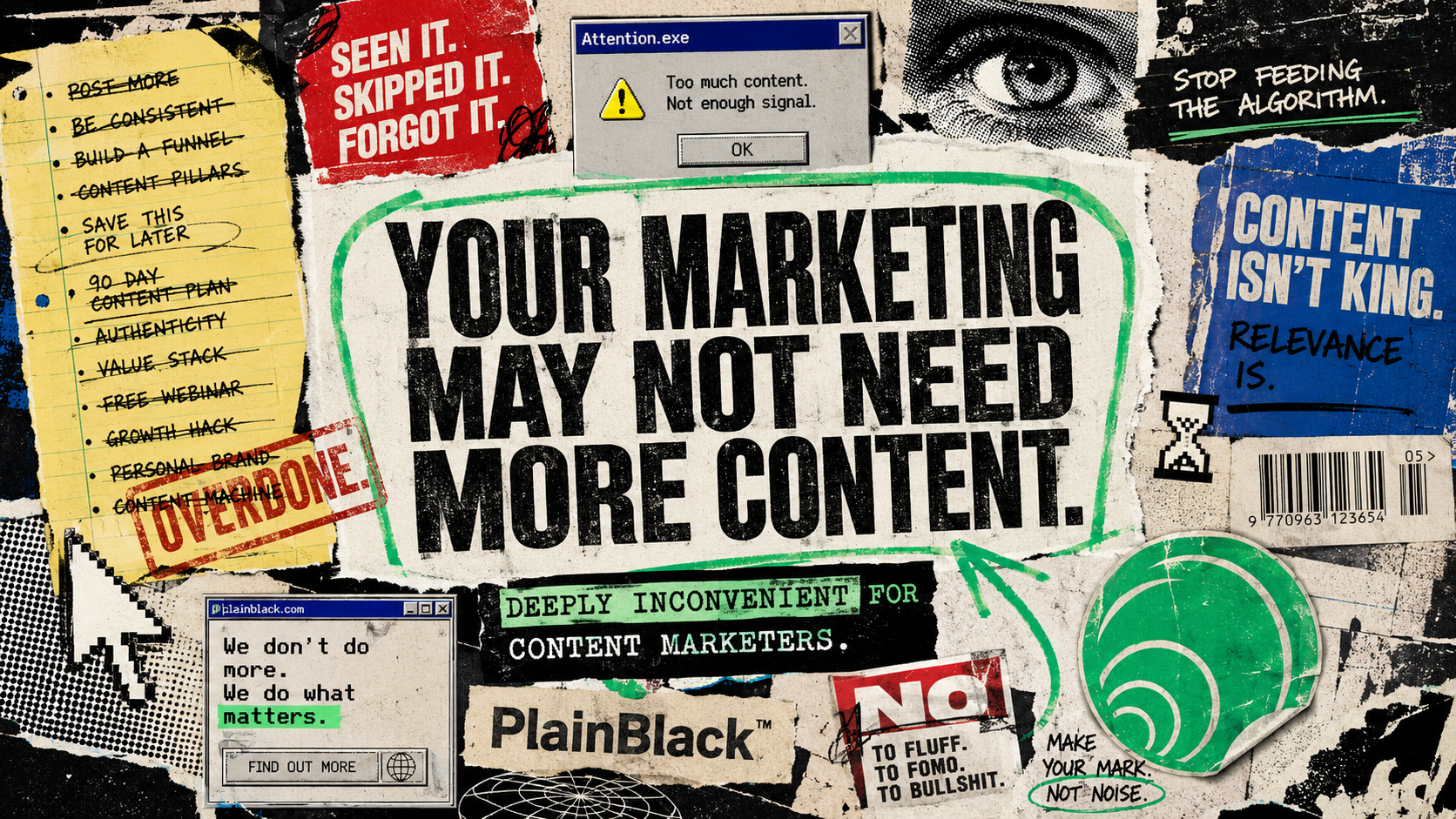
Some businesses don't have a content problem
They have a why-should-anyone-care problem.
That sounds harsher than it is. It is not an insult. It is the question every customer is silently asking before they spend money. Why this business? Why now? Why should I trust you? Why should I pay that? Why not the other mob? Why not keep ignoring the problem until it becomes a more expensive problem with legal paperwork?
That question sits underneath almost every buying decision. Most content never answers it. It dances around it. It posts tips. It shares behind-the-scenes photos. It says we're passionate about quality. It posts a blurry photo of a ute and says another job done.
Wonderful. The algorithm wept. But the customer still does not know why they should choose you. They know you exist. They may know you own a branded polo. That is not the same as trust.
The bar
Your customer is not thinking I hope a local business gives me more content today. They are thinking: can this person solve my problem without making my life harder? Everything else is garnish. And garnish is lovely, unless the steak is missing.
More content can expose the weakness faster
This is the bit that should make a few content marketers cough into their KeepCup.
If the business has a weak offer, vague positioning, thin proof, or a website held together with cable ties and optimism, more content does not fix it. It amplifies it. You are not building visibility. You are making the gap more visible.
If your website does not explain what you do, more posts send more people to a page that still does not explain what you do. If your offer sounds like everyone else's, more content helps more people realise you sound like everyone else. If your only point of difference is friendly service, congratulations, you have entered a knife fight holding a marshmallow.
Content is also a very tidy hiding place. It feels productive. It fills the calendar. It looks like progress from a distance. But content is sometimes just where the hard decisions go to die. The hard decision might be that your prices need explaining, your best customers are not the people you keep targeting, or your about us page has the emotional force of a tax receipt.
Those are fixable problems. They are not fixed by posting 5 tips for choosing a good provider every Wednesday until the sun burns out.
Ask the nastier questions first
Before more content, ask useful-nasty questions. Not motivational-nasty. Commercial-nasty.
- Why should someone choose you, and can anyone actually see that?
- What does your website fail to explain?
- Where are people hesitating before they enquire?
- What do people misunderstand about your price?
- What are you afraid to say because it might turn some people away?
- What do your reviews keep saying that you barely mention?
That last one matters most. Your customers will often hand you the message on a plate. Not a fancy plate. Usually one of those chipped ones from the back of the cupboard that everyone pretends is still fine. They explained everything. They showed up when they said they would. They didn't make us feel stupid. They fixed what the last person stuffed up.
That is not fluff. That is the market telling you where the trust is. And then businesses ignore it to post another generic tip. Stop stepping over gold to pick up wet cardboard.
A plumber does not need to become a media company. A cafe does not need to become a media company. A family-run accommodation business does not need to become a media company. They need to become easier to trust, easier to understand, easier to find, and harder to confuse with the other lot.
So, no, your marketing may not need more content. It may need more nerve. More specificity. More proof. The willingness to say this is who we are for, this is who we are not for, and this is why we cost what we cost. Content can help with that, but only after the business has something worth paying attention to. Start there. Everything else is just feeding the machine and hoping it burps out a customer.