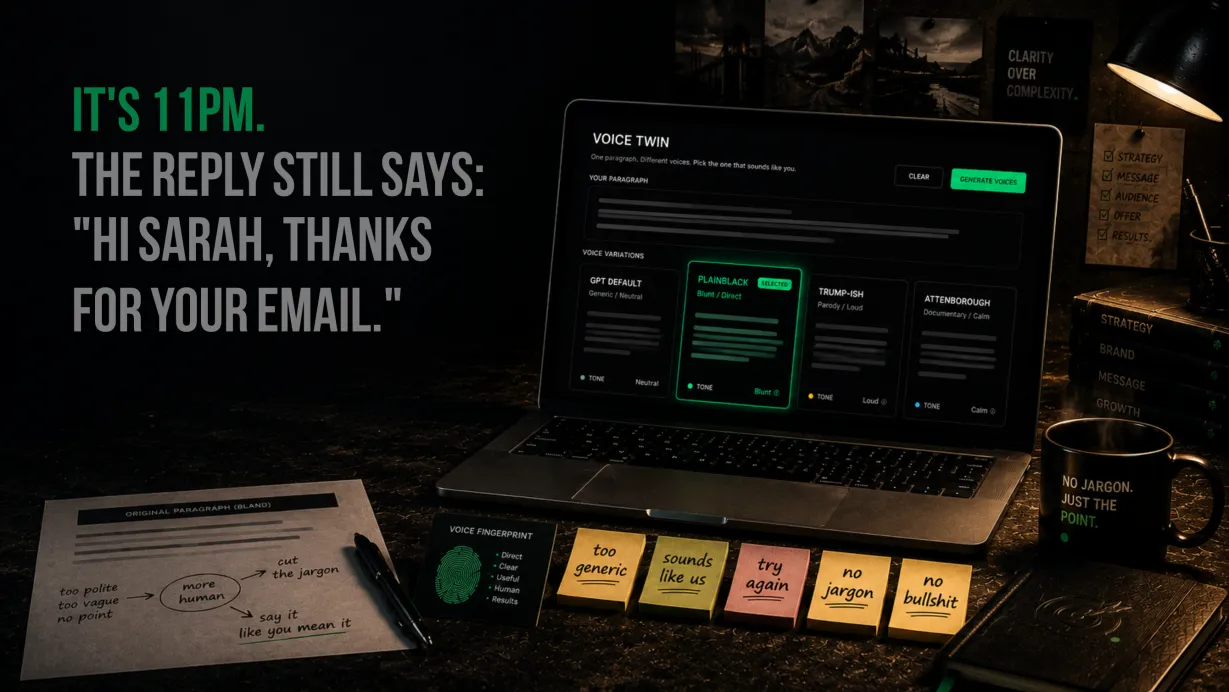
It's 11pm.
The customer email came in at 9:13 this morning.
You opened it three times.
You mentally replied in the car.
You thought about it while making dinner.
You definitely answered it in the shower, where apparently all useful business communication briefly becomes available before evaporating into steam like some sort of cursed productivity ghost.
Then you sat down to actually write the thing.
And somehow your brain produced:
'Hi Sarah, thanks for your email.'
Magnificent.
Twelve hours. Four words. One of them is Sarah's name.
This is where AI should help.
Not by turning you into a LinkedIn thought leader with a ring light and a content calendar called Authority Nuggets. Not by writing 'I hope this message finds you well', which is less a sentence and more a cry for help wearing business casual.
AI should help you get the thing out of your head and into words that still sound like you.
The translation problem
Most small business owners do not have a content problem. They have a translation problem.
They know what they mean. They know what they would say if they had the time, sleep, emotional bandwidth, and perhaps a small monk-like writing assistant sitting quietly in the corner with tea.
But they do not always have access to that version of themselves at 11pm.
So they ask AI for help. And AI says: 'Absolutely! Here's a polished and professional version...'
Which is usually where the whole thing starts smelling like laminated conference lanyards.
The problem is not that AI writes badly. That would be easier. The problem is that AI often writes adequately.
It writes sentences that are technically correct. Pleasant. Balanced. Clean. Dead behind the eyes.
Like a real estate agent describing a laundry as 'well-appointed.'
Nothing is wrong, exactly. But nothing is you.
Your customers are not just reading for information. They are reading for trust. They are trying to work out: Do I believe this person? Do they understand my problem? Do they sound like they have actually done the thing?
Voice is not decoration. Voice is evidence.
It tells people how you think before they ever book the call, send the enquiry, or hand over money.
What we built and why
Voice Twin is a live demo. Paste in a customer enquiry, comment, or DM. Four replies appear side by side.
Three of the replies come from voices we have already trained, each with its own rhythm and register. The fourth is the GPT default: the polished, em-dash-heavy, emoji-garnished version you have probably already received this week. The one that signs off with a hashtag brick and a 'let me know if you would like me to adjust the tone' nobody remembered to delete.
The contrast is the whole point. Three replies sound like a person. One sounds like a robot wearing a name badge.
If we can train three voices that distinct from text rules alone, we can train yours.
Your voice is a pattern, not a prompt
This is where most people go wrong. They tell AI: 'Make this sound more like me.'
AI has no bloody idea what that means. So it usually makes the text shorter, adds a contraction, removes one semicolon, and calls it a day.
Or worse, it starts performing 'authenticity', which is how you get business copy that sounds like a TEDx speaker trapped inside a kombucha fridge.
Your voice is not just tone. It is a pattern. It is: the words you use, the words you avoid, how direct you are, how much context you give, how you explain risk, how you handle objections, how you apologise, how you challenge people, how you joke, where you pause, where you get annoyed.
What you believe. What you refuse to pretend.
That last one matters. Because the strongest business voices are not built from adjectives. They are built from judgement.
A good voice system should know: 'This person would say that.' 'This person would never say that.' 'This sounds close, but too polished.' 'This needs to be warmer.' 'This needs to stop tap dancing and get to the point.'
That is not a prompt. That is a trained writing fingerprint.
What this means for someone running a small business
Most small business owners are not short on things to do. They are buried under things to do. Quotes. Invoices. Messages. Staff. Suppliers. Customers. Content. Website updates. Emails. Follow-ups. The great unpaid evening shift of running a business.
Then someone tells them to 'use AI.'
Helpful. Like handing someone a chainsaw during a kitchen fire and saying, 'This should speed things up.'
It might. But only if they know what they are cutting.
Otherwise AI just helps them produce more of the wrong thing, faster. More posts that sound like everyone else. More emails that feel slightly off. More website copy that says 'quality service' as if any business is out there proudly offering haunted mediocrity.
More content noise. More bland. More almost-right.
And almost-right is dangerous. Because it feels productive. It feels like work happened. But the customer still does not understand why they should choose you.
The useful question
Before you publish, send, post, or paste the next AI-assisted thing, ask: 'Would my customer believe this came from me?' Not 'Is this grammatically correct?' Not 'Does this sound professional?' Would they believe it came from you? If the answer is no, fix that bit first.
We can build one for you. Not a generic 'friendly professional' voice. Not a prompt that says 'Write in a warm, clear, human tone.' We build a voice system from how you actually speak and write. Your emails. Your posts. Your offers. Your explanations. Your little phrases. Your pet hates. The things you over-explain. The things you under-sell. The bits your customers already respond to. The stuff that makes people say, 'Yep, that sounds like you.'
Then the AI stops being a content vending machine. It becomes more like a tired-but-useful version of your communication brain.
You still decide. You still approve. You still bring the judgement. But you are no longer starting from a blank page while your soul slowly leaves through the keyboard.
Day 17 of 30. 13 days to go.
Built the Voice Twin: a live demo of the AI voice tools PlainBlack builds for small businesses. Try it at plainblackcreative.com/tools/voice-twin.