You can waste a lot of money asking the wrong question.
Small businesses get sold answers all day.
Run ads.
Post more.
Make videos.
Use AI.
Fix your SEO.
Redesign the website.
Start a newsletter.
Build a funnel.
Fine. Some of that might help.
But if you have already tried the website, the video, the boosted posts, the content calendar, the AI tool, the SEO person, or the "just post consistently" advice, and nothing moved, the next question should not be:
"What should I buy next?"
It should be:
Why didn't the last thing work?
That is the expensive question.
Because if you get that wrong, every next solution gets expensive.
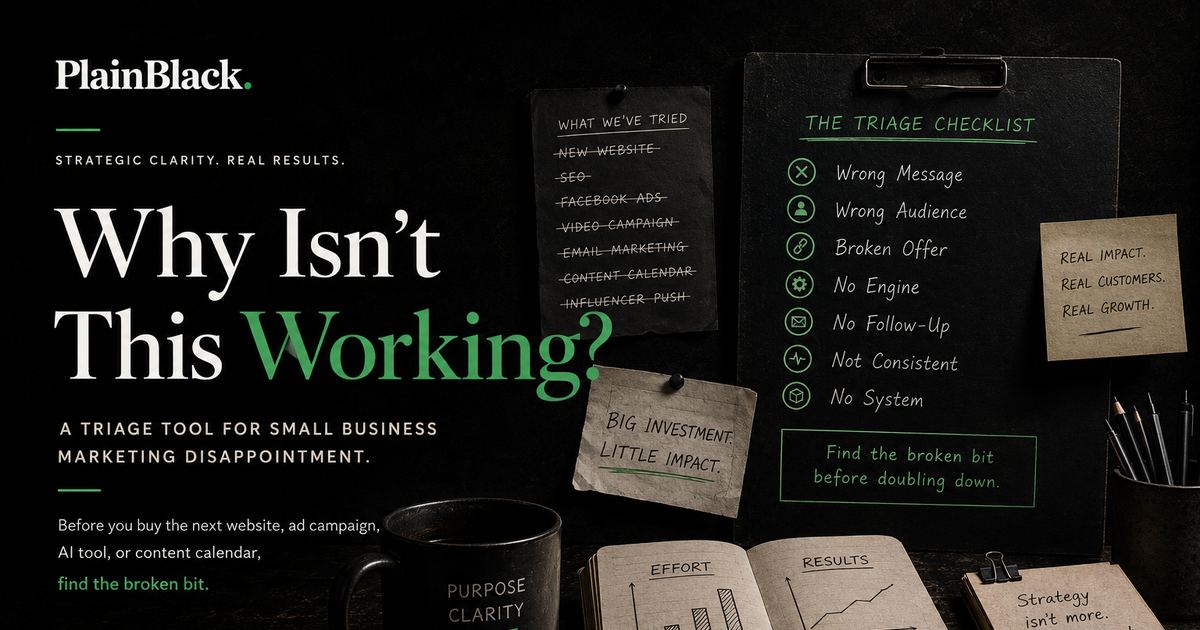
The problem is usually upstream
A video can be beautifully shot and still do nothing.
Not because the video is bad. Because nobody gave it a job.
- Where does it live?
- Who is meant to see it?
- What should they understand after watching?
- What should they do next?
If the answer is "it's for brand awareness," congratulations, you have purchased a very cinematic shrug.
Same thing with ads.
An ad can get clicks and still fail. The ad did its bit. It got attention. Then it sent that attention to a page that couldn't explain the offer, earn trust, or make the next step obvious.
The problem was not the ad.
The problem was the path after the ad.
Same thing with social.
Posting every week and getting no interaction does not automatically mean social media is dead. It might mean the posts have no point, no opinion, no useful tension, no reason for the right person to care.
"Happy Friday" has never saved a business.
It barely saves Friday.
Same thing with AI.
AI can write a post. It cannot decide what you believe.
If you give it no opinion, no customer context, no examples, no standards, and no reason for the post to exist, it will produce perfectly spelled wet cardboard.
That is not an AI problem.
That is a thinking-layer problem.
Most marketing advice sells the next thing
This is the bit that annoys me.
Small business owners are already stretched.
Costs are up. Customers are slower to decide. Every tool wants a subscription. Every platform wants attention. Every marketer with a ring light has a framework.
And somehow the advice is still:
Spend more.
Boost it.
Post more.
Run another campaign.
Make another video.
Try a new platform.
Redesign the website.
Use better hooks.
Add AI.
Remove AI.
Be authentic.
Be strategic.
Be consistent.
Be a thought leader.
Be serious.
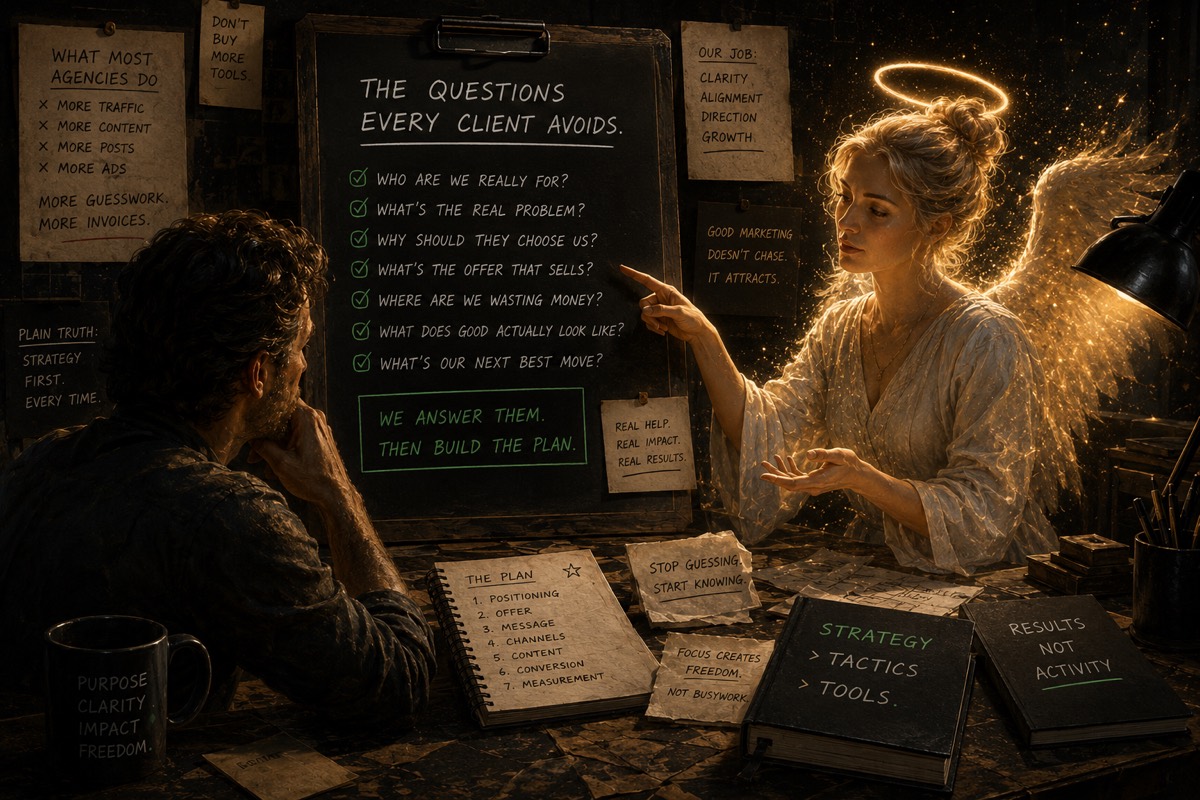
Most marketing advice sells the next thing before checking why the last thing failed.
That is backwards.
If the page is unclear, more traffic gives more people a chance to leave.
If the offer is vague, more content gives the confusion a publishing schedule.
If the video has no next step, another video just gives you a second expensive thing to admire sadly.
If AI is writing slop, another prompt pack will not fix the fact that nobody has given it a useful thought to sharpen. The fix lives upstream of the tool: in the brief, the voice samples, the customer questions, the standards. The kind of thing we build with businesses before we touch any tool.
A wrong diagnosis makes every solution expensive.
So I built a diagnostic
Day 11 of the 30-Day Build Challenge: I built Why Isn't This Working? (You can see everything we've shipped this month on the tools page.)
It is a small-business marketing triage tool.
Not a quiz pretending to be a sales funnel.
Not a calculator with fake precision.
Not a "book a call" form wearing a novelty hat.
You tell it what you tried, what happened, and what you hoped would happen.
It asks about the thing you spent money, time, or hope on:
- Website
- Ads
- Video
- Social media
- AI tool
- Content calendar
- SEO
- Google Business Profile
- Something else
Then it looks for the likely broken bit:
- Message clarity
- Offer-market fit
- Wrong traffic
- No obvious next step
If you give it a URL, it can also scan the page and pull in real signals, so the diagnosis is not just vibes in a trench coat.
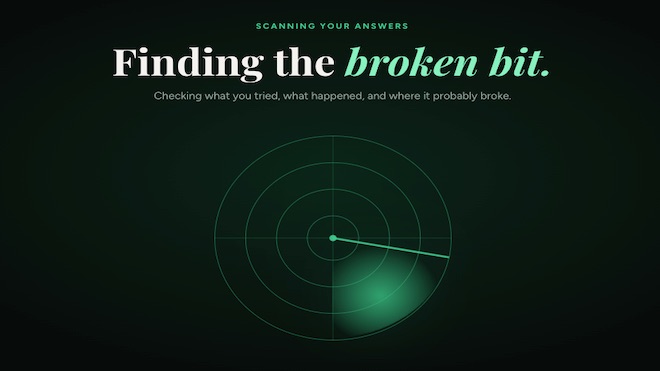
The result is not a giant report.
It gives you:
- What is probably broken. One blunt diagnosis, not a fence-sit.
- Why it feels like nothing worked. The reason the effort isn't moving you forward.
- What to fix first. The fix order, in plain English.
- What not to buy next. The waste patterns to avoid.
- One useful next move. A concrete action for the next 48 hours.
That last part matters.
Because the goal is not to make you feel impressed.
The goal is to stop you buying the wrong thing next.
A few examples
If you say:
"I paid for a video and it did nothing."
The useful diagnosis is probably not:
"Make another video."
It might be:
You bought attention, but not a next step.
The fix is not necessarily more production. It might be a campaign page, a sharper CTA, cut-down clips with a clear purpose, or a better path from "nice video" to "I should talk to these people."
If you say:
"I post every week and nobody cares."
The useful diagnosis is probably not:
"Post more consistently."
Please stop threatening exhausted business owners with consistency.
It might be:
You do not have a posting problem. You have a reason-to-care problem.
The fix might be a stronger opinion, clearer customer problem, better proof, or posts built from actual sales conversations instead of content calendar confetti.
If you say:
"Everyone says AI will save time, but it writes garbage."
The useful diagnosis is probably not:
"Use this 47-part prompt."
It might be:
You do not need an AI writer. You need a thinking layer.
The fix is giving AI the actual ingredients: your point of view, your examples, your customer questions, your banned phrases, your standards, and the job the content needs to do.
AI can write.
It cannot care on your behalf.
This is the real product
The public tool is useful by itself.
But the bigger thing is the thinking behind it.
PlainBlack is not trying to sell small businesses more marketing activity. The world has plenty of activity. A lot of it is wearing a dashboard and making everyone tired.
We are trying to help business owners find the part that matters first. Sometimes that part is:
- the website
- the offer
- the message
- the follow-up
- a tiny missing bridge between a thing they already paid for and the action they hoped it would create
That is why this tool matters.
It is not just a diagnostic.
It is a filter for bad advice.
Because if the broken bit is the page, you do not need more ads yet.
If the broken bit is the offer, you do not need more content yet.
If the broken bit is the next step, you do not need another brand video yet.
If the broken bit is your thinking, you do not need AI to write faster. You need a clearer thought for it to work with.
Good marketing should save you from waste
Good marketing should not make you more dependent, more confused, or more convinced that the answer is always another monthly subscription.
It should help you see what is working, what is wasting time, and what needs fixing first.
Sometimes the best next move is not bigger.
It is smaller, sharper, and annoyingly obvious once someone points at it.
- Fix the page before buying traffic.
- Give the video a job before making another one.
- Clarify the offer before posting more.
- Decide what you believe before asking AI to write it.
- Find the broken bit before you spend more money decorating the leak.
That is what I built today.
Try it here: Why Isn't This Working?
And if the result makes you feel personally attacked by a polite green radar, good.
That probably means it found something.