Every generation thinks it is the first one to face scary new technology.
Every generation is wrong.
Something new arrives. Someone clever works out how to make hard things faster. A bunch of people immediately clutch their pearls, declare the end of civilisation, and act like the devil has personally launched a productivity tool.
Then, ten years later, everyone is using it to order lunch, run payroll, book flights, write invoices, find plumbers, avoid phone calls, and look up whether possums can legally own property.
They cannot, apparently. Though I have met a few landlords who make the question feel worth asking.
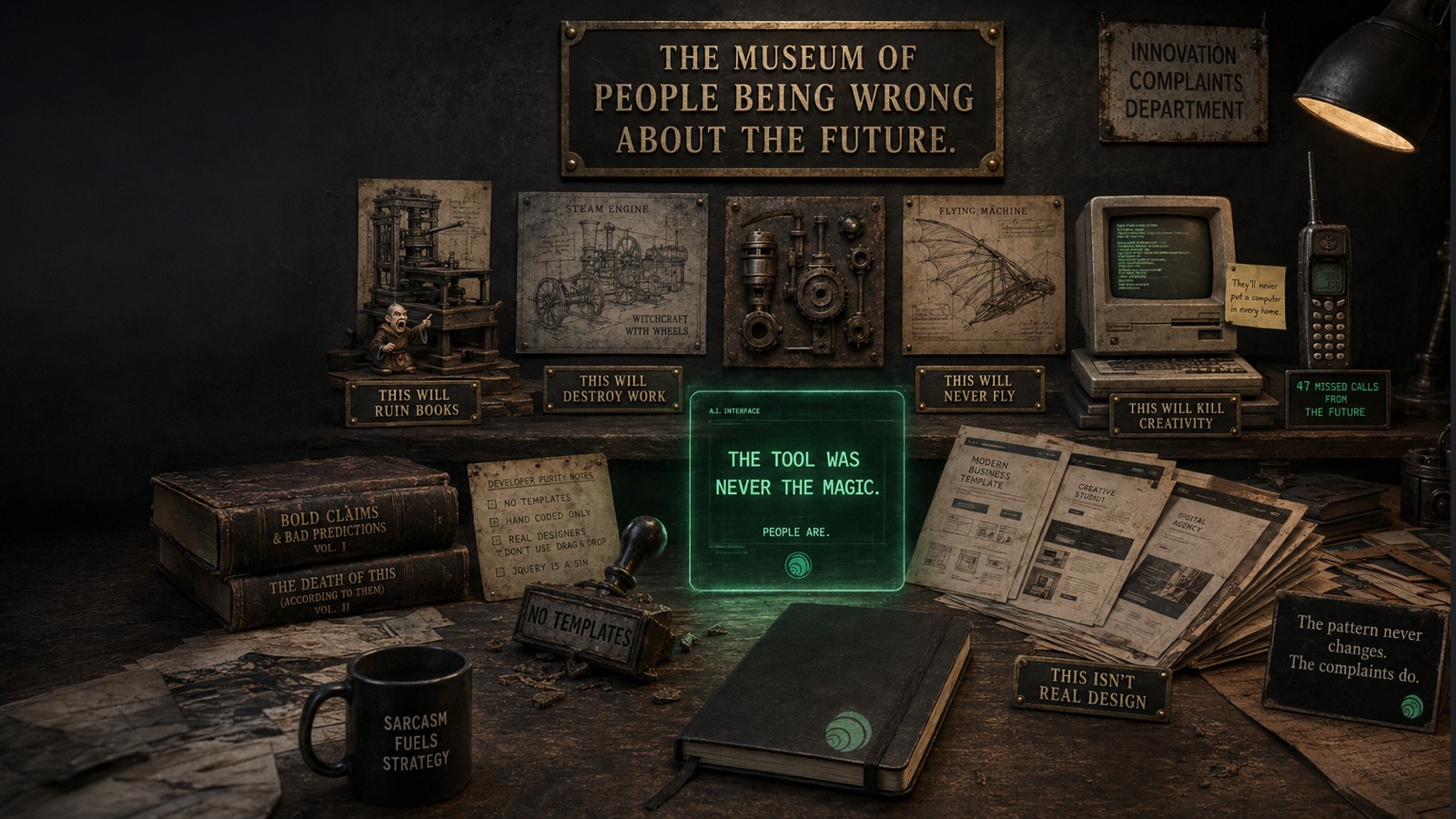
We have been here before
When the printing press arrived in Europe in the mid-1400s, it changed the speed and scale of information. Before that, books were slow, expensive, hand-copied things. Gutenberg's movable-type press helped turn knowledge into something that could spread properly.
Naturally, some people hated it.
The old gatekeepers had a good thing going. If knowledge is slow, rare, expensive, and controlled, the people controlling it get to feel very important. Then some bloke comes along with movable type and suddenly the monopoly starts sweating through its robes.
The printing press did not remove human thought. It multiplied it. It did not kill writers. It created more readers. It did not destroy ideas. It made ideas harder to imprison.
And yes, it also helped spread nonsense faster, because humanity has always been committed to ruining nice things. But the answer was not to uninvent printing. The answer was to get better at thinking, filtering, publishing, teaching, arguing, and creating.
Textile machinery, railways, cars, planes, computers, mobile phones. The pattern is not subtle. Technology arrives as a threat, becomes a tool, then disappears into normal life so completely that people forget they ever resisted it.
During the Industrial Revolution, textile machinery threatened old forms of work. The Luddites became famous for destroying machines they believed were displacing them. The real story is more complicated than 'stupid people hated machines.' They were worried about jobs, pay, quality, power, and owners using machinery to crush workers.
But you cannot smash the direction of history. The machine comes back. Usually with a better version number and worse documentation.
Railways were feared. People worried about noise, danger, disruption, property, animals, morals, bodies, minds, probably hats. Then trains became infrastructure.
Cars arrived. People feared speed, accidents, pollution, congestion, and the collapse of existing industries. They were not entirely wrong. That is the annoying bit. The critics are often partly right. New technology does bring new problems. But being partly right about the risks is not the same as being right to reject the shift.
AI is the same argument with a scarier mask
Before AI, we had another version of this argument in web design. Remember when people sneered at developers or designers who used WordPress? Then Squarespace. Then Wix. Then Webflow. Then Shopify themes.
The argument was always dressed up as purity. 'Real developers code from scratch.' 'Real designers don't use templates.' 'Real businesses need bespoke everything.'
Sometimes true. Often absolute theatre.
Because a template is not a strategy. A template is not a brand. A template is not positioning. A template is not the sales conversation. A template is not the offer, the copy, the customer journey, the photography direction, the enquiry flow, the trust signals, the conversion structure, or the hundred tiny decisions that make a website actually work.
A template is scaffolding. And if you think scaffolding builds the house by itself, congratulations, you have the strategic depth of a damp Weet-Bix.
The best people used templates to move faster. Not because they had no skill. Because they had enough skill to know where the real work was. The amateurs either worshipped templates as magic or rejected them as cheating. The professionals used them as tools.
The uncomfortable bit
AI does not remove human innovation. It exposes whether there was any there in the first place.
People are acting like using AI means human creativity has packed a suitcase, left the house, and now lives in a caravan park called Mediocrity Pines.
No.
If your thinking is weak, AI will help you produce weak thinking faster. If your offer is vague, AI will help you say vague things in cleaner sentences. If your brand sounds like everyone else, AI will help you become even more everyone else than you already were.
Lovely. A beige cannon. Fire at will.
But if you have taste, judgement, experience, curiosity, humour, restraint, and a genuine understanding of your customer, AI becomes leverage. It helps you draft. Explore. Compare. Pressure-test. Prototype. Summarise. Repurpose. Generate options. Find angles. Speed up the ugly middle bit between 'I have an idea' and 'this might actually be useful.'
It does not replace the human. It punishes the human who was only pretending to add value. Which might be why some people are so upset.
When production gets easier, taste becomes more important
There are real concerns with AI. Copyright matters. Originality matters. Accuracy matters. Labour matters. Privacy matters. Bias matters.
The internet already had enough low-quality content without every half-interested business owner asking a robot to write '10 reasons why our team is passionate about solutions' and publishing it like a proud parent at a school concert for taxidermy.
So no, the answer is not 'use AI for everything.' That is lazy. But 'don't use AI because it's scary' is also lazy. Different costume. Same intellectual nap.
The useful question is not: 'Is AI good or bad?' The useful question is: 'Where does AI remove friction, and where must human judgement stay firmly in charge?'
Because that is where the win is. Not in replacing creativity. In clearing the crap around it.
The printing press did not kill writers. The camera did not kill art. Recorded music did not kill live performance. Templates did not kill web design. Canva did not kill graphic design. AI will not kill creativity.
But it will kill a lot of hiding places. It will make average work easier to produce. Which means average work becomes even less valuable.
When production gets easier, taste becomes more important. When tools get faster, judgement becomes more important. When everyone can make something, the advantage moves to the people who know what should be made, why it matters, who it is for, and how to make it feel unmistakably theirs.
The winners are not the people who fear the tool. They are not the people who blindly worship it either. The winners are the creative, strategic, commercially aware people who pick it up, test it, bend it, break it, question it, improve it, and use it to get to better work faster.
Same as always.
Every technological shift creates three groups. The first group fights it. They stand at the edge of the new thing, waving a tiny moral clipboard, explaining why it should not exist. The second group worships it. They think the tool is the answer, which is adorable in the same way a toddler wearing a saucepan as a helmet is adorable.
The third group gets to work. They learn what the tool is good at. They learn what it is terrible at. They keep their standards. They keep their taste. They keep their humanity. They use the machine to remove drag, not responsibility.
That third group usually wins. Not because they are fearless. Because they are useful. And useful beats precious. Every time.
So yes, be cautious. But don't be useless. Fear is not wisdom. Scepticism is useful. Panic is not. Question AI. Absolutely. Challenge the output. Protect your voice. Check the facts. Keep your standards high. Do not publish robotic landfill and call it marketing.
But do not confuse fear with integrity. Some people are not defending creativity. They are defending the old amount of time it used to take to look competent. That model is dying. Good. Let it.
Because the future does not belong to the people who sneer at tools from the sidelines. It belongs to the people who can still think when the tools get faster. And that has always been the point. The machine never was the magic. The magic is the human with enough imagination to use it properly.