You have seen them.
The $27 workshop. The $19 mini-course. The $7 template pack. The 'steal my entire system for less than the price of two sad servo sandwiches' offer.
They are everywhere. Branding. AI. Content. Funnels. Canva. Passive income. Social media. Business growth. Usually with a headline that sounds like someone has just uncovered a conspiracy involving your logo, your childhood wounds, and a free workbook.
And to be fair, some of them are good. Some are genuinely useful. Some give you a quick win, a clearer way to think, or a simple tool you can actually use.
But the important thing to understand is this: the cheap thing is often not the business model. It is the doorway.
The tripwire
In marketing, this is often called a tripwire. A low-cost offer designed to turn a stranger into a buyer. Not a follower. Not a lead. A buyer.
That distinction matters. Because once someone buys something, even something cheap, the relationship changes. They have crossed a small psychological line. They have said: 'I have this problem. I trust you enough to help. I am willing to spend money on solving it.'
That is valuable. Not evil. Valuable.
Marketing people can get very weird about this, like they have discovered forbidden magic in a cave behind Russell Brunson's house. But the mechanism itself is simple. A low-risk offer lowers friction. It gives the buyer a taste. It builds trust. It creates momentum. And if it is done well, everyone wins.
A good tripwire should stand on its own. A low-cost offer should be useful even if the buyer never purchases anything else.
When it becomes a problem
The problem is not the tripwire. The problem is when the tripwire is not designed to help. It is designed to unsettle.
You buy the $27 thing thinking you are going to get clarity. Instead, you get a partial answer, three new problems, a long story about why your current approach is broken, and a workbook that somehow creates more homework than a Year 9 maths teacher with a grudge.
And then, conveniently, the real answer is available in the next offer. For $997. Or $2,997. Or twelve monthly payments of 'this seemed reasonable during the webinar.'
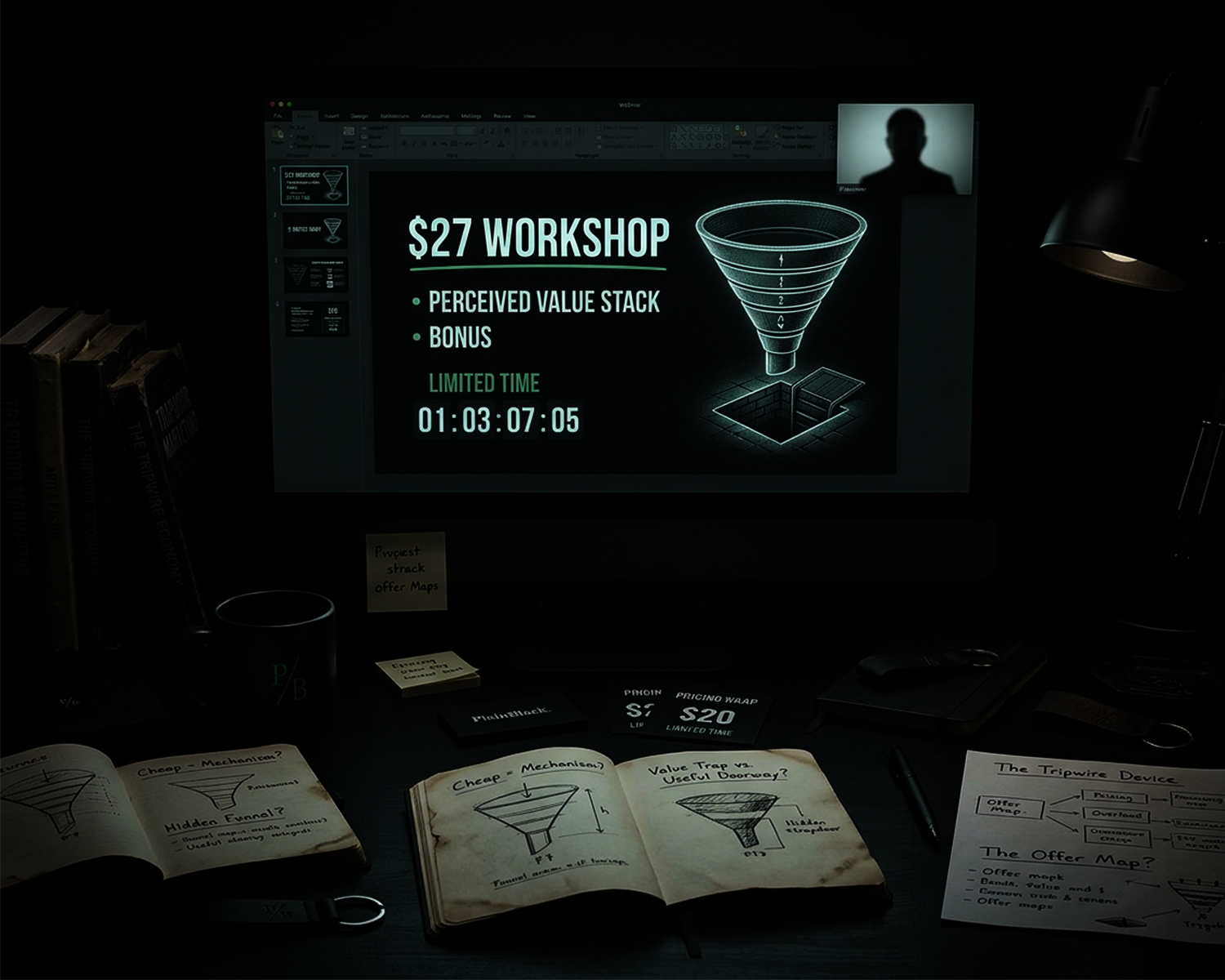
That is when the tripwire becomes a trapdoor.
The real test
Here is the simple test. After the cheap offer, the buyer should be able to say: 'I know what to do next.'
Not: 'I think I need to buy the bigger thing because now I feel worse.'
That is the difference between a useful doorway and a trapdoor. The doorway gives you a way in. The trapdoor drops you into a sales sequence wearing a name badge that says 'limited time bonus.'
Good marketing makes the problem easier to understand. Bad marketing makes the problem feel bigger, scarier, and more urgent than it was before. Good marketing gives you a next move. Bad marketing opens a loop and sells you the privilege of closing it later.
Ask this before buying the next tiny workshop or mini-course: what will I actually be able to do after this? Not 'what will I learn?' Doing matters more. Will I have a clearer offer? Will I know what to fix first? Will I understand my customer better? Will this save me time? Will this make my next decision easier?
If the answer is vague, the offer probably is too. And if the page spends more time telling you how broken you are than showing you what you will walk away with, maybe keep your card in your pocket for a second.