A year ago, this would have taken months.
Not 'a couple of focused weeks and a few long coffees' months.
Actual months.
Whiteboards. Wireframes. Scope creep. Developer meetings. Budget pain. Someone saying 'phase two' like it was not just a polite way of putting your dreams in a shallow grave.
And now Jayden has gone and built the thing.
Which is annoying, obviously, because now I have to find a new category for 'things that are impossible.'
The idea is stupidly simple
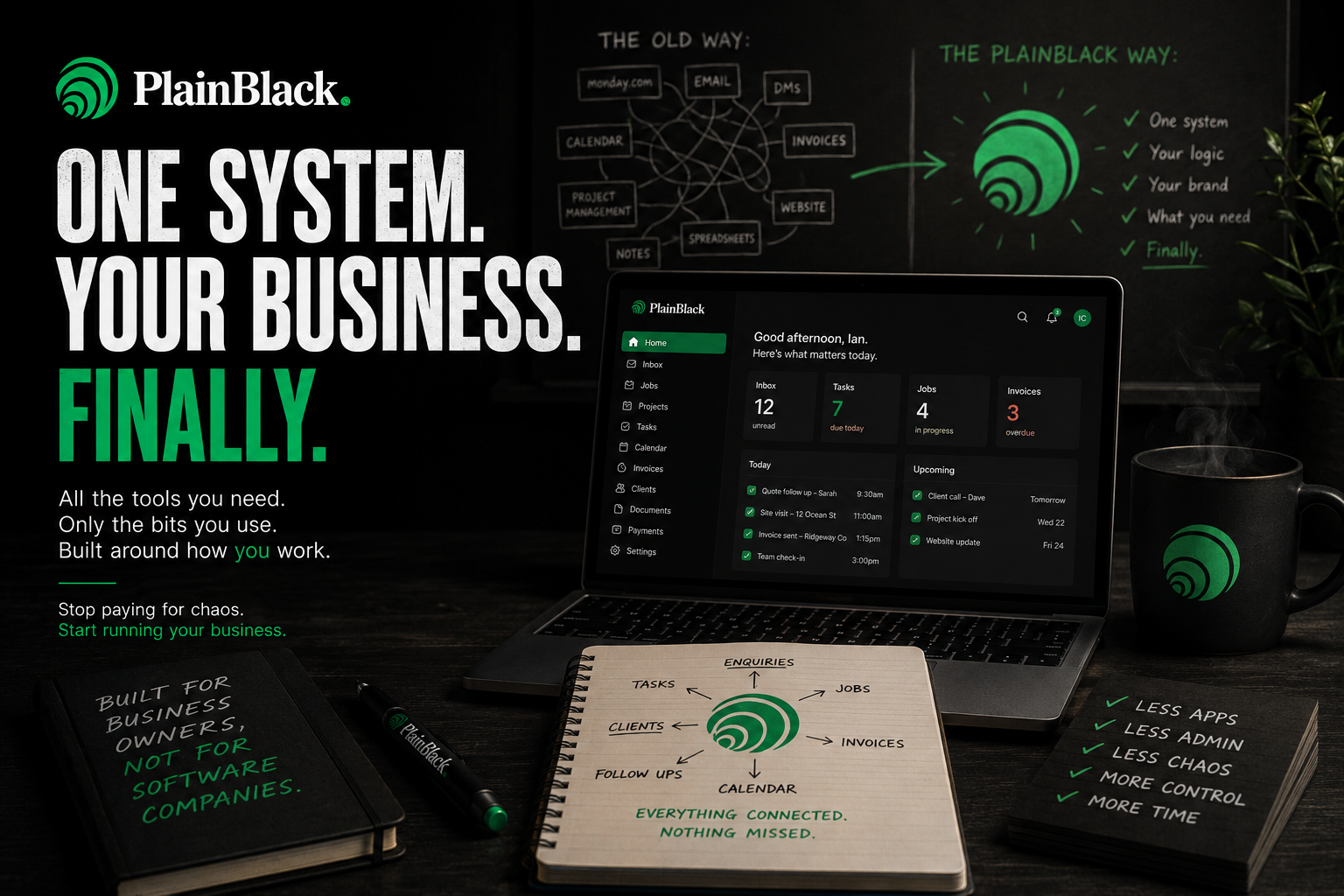
Imagine you took all the apps a small business uses to stay vaguely functional.
Monday. Email. DMs. Project management software. Your CMS. Calendars. Task lists. Invoices. Quotes. Notes. Follow-ups. Random spreadsheets called 'FINAL-final-new-new-use-this-one.xlsx.'
Now imagine all those apps had a meeting.
Not a corporate meeting with stale biscuits and someone saying 'circle back.'
A useful meeting.
Imagine they all sat down and asked: 'What does this business owner actually need?'
Not what some software company thinks they need. Not what a SaaS pricing page wants to upsell them into. Not what an operations guru on LinkedIn thinks looks good in a carousel.
What they actually use. What they actually check. What they actually forget. What they actually need in front of them when they are tired, mildly furious, and trying to remember whether Dave from Tuesday accepted the quote or just reacted to the message with a thumbs up.
That is what Jayden built.
A custom business operating system. Not in the 'look at us, we invented a fancy term' sense. In the very practical sense of: your business, your brand, your logic, your workflow, your useful bits, all in one place. Without the logins and the quiet monthly bleeding of subscriptions you barely remember signing up for.
Most platforms are built for everyone, which means they are built for no one
Small business owners have been sold the same lie for years: 'You need better software.'
Maybe. But often, no. Often you do not need better software. You need software that understands your business.
There is a difference.
Most platforms give you 300 features, and you use seven of them. Then you spend the next six months trying to remember which menu the useful one lives in. That is not efficiency. That is hide and seek with a login screen.
And because each app only handles one slice of the business, the owner becomes the glue. You are the integration. You are the notification centre. You are the human API, wandering around with a coffee, trying to manually connect your inbox, your calendar, your quotes, your tasks, your website, and your brain.
No wonder everyone is cooked.
A plumber does not need the same system as a wedding photographer. A café does not need the same workflow as an accountant. Small businesses are not smaller versions of big businesses. They are their own weird, brilliant, held-together-with-caffeine ecosystems.
They have habits. Shortcuts. Pain points. Repeated questions. Seasonal chaos. Staff quirks. Customer quirks. Owner quirks. And when software ignores that, the owner has to bend themselves around the tool.
That is backwards. The tool should bend around the business.
AI changed the timeline, not the thinking
This is where AI and modern development have changed the game. Not because AI magically solves everything. It does not. AI can still produce absolute sludge at industrial speed if nobody is steering the thing.
But when someone with actual business understanding uses it properly, the timeline collapses. Things that used to need a dev team, a giant budget, and a terrifying Gantt chart can now be prototyped, tested, and shaped much faster.
That does not make thinking less important. It makes thinking more important. The tool can build faster. But someone still has to know what should be built.
That is the bit people keep skipping.
The value is not 'we can make an app.' Congratulations. So can half the internet now. The robots have joined the group chat and they brought snacks.
The value is knowing what the app should remove from the owner's day. What it should connect. What it should ignore. What it should make obvious. What it should stop the owner from having to remember. What it should protect them from missing.
That is the difference between another shiny tool and an actual useful system.
Most business owners do not need more dashboards. They need fewer loose ends. They need the quote to connect to the follow-up. They need the enquiry to connect to the job. They need the customer message to connect to the task. They need the website update to not require a small ceremonial sacrifice.
They need to see what matters today, not be gently assaulted by every feature the software company invented to justify the premium plan.
And when it is built around them, in their brand, using their language, with the bits they actually use, something interesting happens. The system stops feeling like admin. It starts feeling like control.
That matters. Because control is what most small business owners are really trying to buy. Not software. Not marketing. Not automation. Not 'digital transformation,' which still sounds like Optimus Prime got a LinkedIn account.
They want to feel like the business is not quietly leaking tasks, leads, invoices, and opportunities through a hole in the floor. They want to know what needs attention. They want to stop double-handling everything. They want fewer things living in their head. They want the business to make sense again.
That is what this thing points toward. A world where a small business does not have to duct-tape together generic tools just to function. A world where your internal system is built the same way your brand should be built: around how you actually work, who you actually serve, and what actually matters. Not around what some platform decided belongs in a left-hand menu.
I am not saying every business needs a custom-built system tomorrow. That would be silly. Some businesses need a spreadsheet cleaned up and a stern talking-to. Some need their website fixed first. Some need to stop paying for software they opened twice and now treat like a gym membership for their conscience.
But I do think this is a serious shift. Because once a business owner sees that their tools can be built around them, it becomes much harder to accept the usual mess. It becomes harder to keep paying for apps when they only use a fraction of each. It becomes harder to pretend admin chaos is just 'part of running a business.' It becomes harder to let the owner remain the glue holding the whole thing together.
The best technology should not make the owner feel more dependent. It should make them more capable. It should give them time back. It should reduce the mental tabs. It should help them make better decisions without needing to become a software archaeologist every time they want to update a job status.
That is why I am excited. Not because Jayden built 'an app.' Apps are everywhere. You cannot throw a croissant in a co-working space without hitting someone building one.
I am excited because he built a thing that proves where this is going. Small businesses are about to get access to tools that used to be reserved for companies with big budgets, internal teams, and consultants who used the word 'ecosystem' too much. But this time, if we do it properly, the tools do not have to be bloated. They do not have to be confusing. They do not have to trap people. They can be simple. Specific. Useful. Built around the business instead of the other way around.
Which, frankly, is how it should have worked all along. But apparently we needed AI, better tooling, and Jayden quietly becoming dangerous at a keyboard before the obvious became practical.
Day 21 of 30. Nine days to go.
Look at the apps you are paying for. Look at the features you actually use. Look at the admin you keep doing twice. Look at the things that only work because you remember to check them. That is where the real opportunity is. Not another subscription. Not another dashboard. A system that fits the business. Radical, I know. Almost like the business owner was the point.