Here is how most agency engagements start.
An owner sends an email that says, in essence: “Hi, can you guys quote us on a new website? Cheers.”
Then one of three things happens.
The agency either ghosts because they can’t price a thing with no shape, or sends back a generic deck and a meaningless number, or worse, books a discovery call that lasts an hour and produces no actual quote.
Nobody wins.
The owner thinks agencies are slippery. The agency thinks owners are vague. Both are slightly right.
The real problem is that nobody wrote the brief.
The brief is the agency’s job, not yours
Yes, agencies should do this. We should run discovery calls, write briefs for clients, and structure the work before sending a quote.
Most don’t. Not because they don’t care. Because doing it properly takes hours per prospect, half the prospects ghost before signing, and the economics fall apart fast when the conversion rate from discovery to engagement is low.
So agencies cut corners on intake. They send templates. They ask three questions in a kickoff meeting and then guess. The brief gets written backwards, after the contract is signed, when nobody has any energy for arguing about it.
That is how scope creep starts.
That is also how the wrong agency wins the work, because the owner couldn’t tell which agency understood the problem.
You can’t compare three agency quotes if none of them quoted against the same thing.
What the tool does
Day 20 of the 30-Day Build Challenge: Get A Brief, Not A Quote.
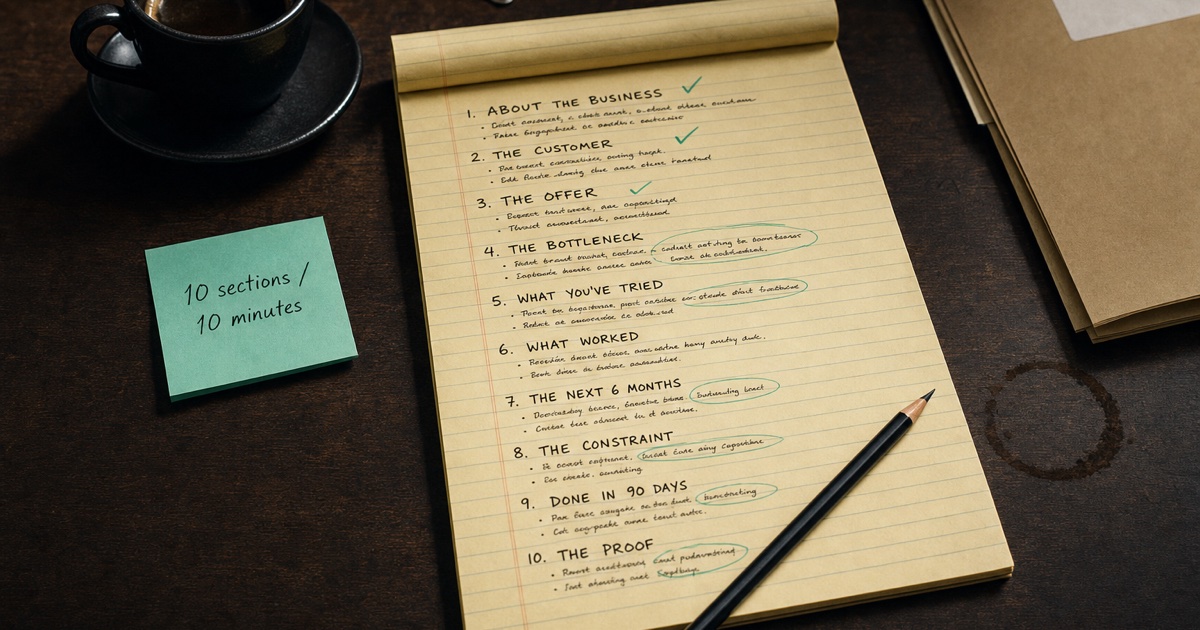
Ten sections, in this order:
- About the business
- The customer
- The offer
- The bottleneck
- What you’ve tried
- What’s worked
- The next 6 months
- The constraint
- What done looks like in 90 days
- The proof
This is the structure we use internally before we quote a client. Some agencies call it discovery, some call it a creative brief, some call it a kickoff doc. The shape is roughly the same wherever the work is done well.
We’ve never seen it offered as a public tool. The standard move is to lock it behind a discovery call, a contract, or both. We decided to put it on the public web with no signup.
You answer one section at a time. Each section has one big question, a hint underneath, and a textarea. As you write, an AI co-pilot reads what you just wrote and mirrors it back in your own words, sharpened.
If your answer to “who is your customer” was “anyone in business who needs marketing”, the mirror reflects:
“You’re saying anyone in business. That’s too broad to brief against. Who pays best right now?”
Not punishing. Honest. The mirror is the part most owners need most. It sharpens the brief before it leaves the page.
What this is actually for
Three real uses.
If you’re a small business owner about to engage any agency. Write the brief first. Send the link with your first email. The right agency answers against the actual scope. The wrong one stops wasting your time. The bonus: writing the brief usually surfaces the bit you didn’t realise was missing.
If you’re an agency or freelancer. Send the link as part of your intake. Saves the discovery call from being the part where the prospect figures out what they actually want.
If you’re considering PlainBlack. Write the brief, send us the link, and we’ll respond against this exact scope, not whatever a sales tool guesses at.
The brief belongs to you either way. We don’t lock it. We don’t require an email. We don’t put you on a list. If you write a brief and decide to use a different agency, send them the link. That’s the entire point.
The brief sharpens the request. The right agency answers. The wrong one stops wasting your time.
This is Day 20 of 30
The 30-Day Build Challenge keeps producing more compounding value than the build challenges that came before it.
Day 1 was the dashboard we use to track the challenge itself. Day 3 was a quote-screener for a roofer. Day 11 was a marketing-triage tool. Day 19 was the homepage filler-score scanner. Day 20 is the agency-brief intake. Each one is a tool we wished existed before we built it, then realised was easier to put on the web for free than to lock behind a contract.
This is what we mean by build-in-public.
Not “look at the dashboards”, although the public tracker is there.
What we mean is: the agency that should win your work is the one willing to put its own tools on the public web. The one that hides everything behind a sales funnel is hiding the work too.
Try the brief: Get a Brief, Not a Quote
If you send it to PlainBlack, we’ll respond. If you send it to someone else, we hope they answer the actual question this time.