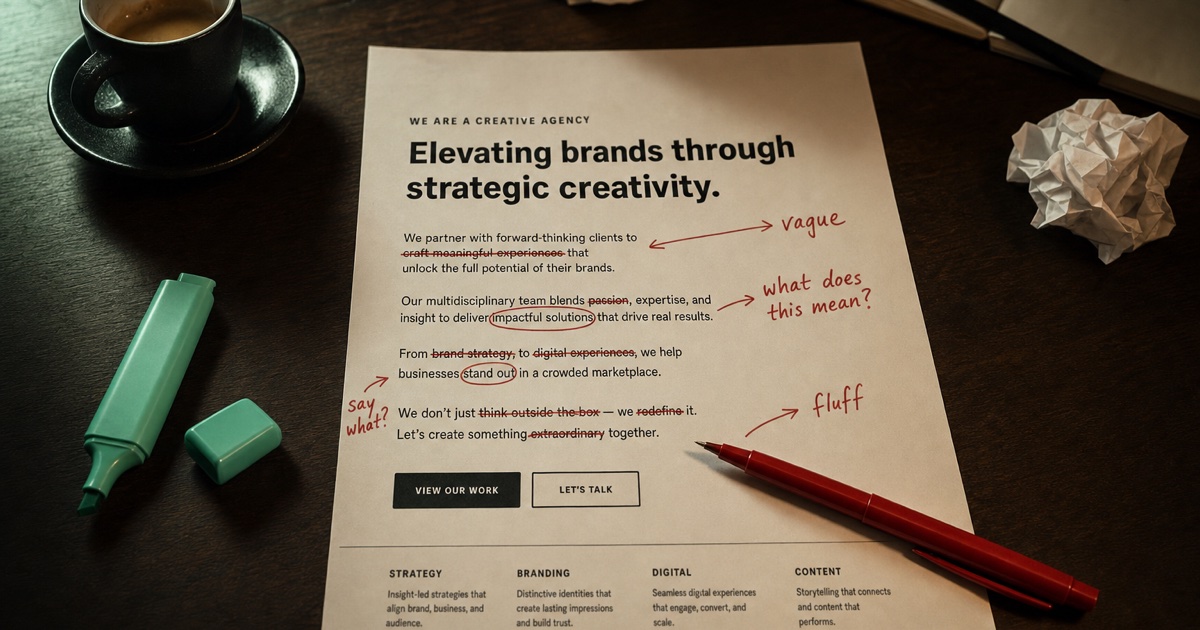
There are a few hundred words that mean nothing on a business website.
“Transform. Elevate. Unlock. Leverage. Solutions. Seamless. Holistic. Robust. Comprehensive. Innovative. Synergy. Ecosystem.”
“Take your business to the next level with our tailored solutions.”
Most homepages reach for them. Roofers do it. Cafes do it. Agencies do it. SaaS does it. Accountants definitely do it.
Buyers read a thousand of these a week. They scroll.
SEO gets them there. The page has to keep them.
This is the bit nobody really wants to talk about, because the SEO economy makes a lot of money pretending the traffic is the work.
A homepage that ChatGPT wrote, that an SEO tool blessed, that hits every keyword on the brief, can still send a buyer straight back to Google.
The words tick the boxes. They just don't say anything.
Keyword stuffing, AI slop, and agency phrasing all share the same tell: they read fine and mean nothing. A visitor lands, scans for the one specific thing about what you do, who buys it, and why this week, doesn't find it, and leaves.
The traffic was real. The page leaked.
Filler is the leak after the click.
So I built a scanner
Day 19 of the 30-Day Build Challenge: Filler Score.
You paste a URL. The tool fetches your headline plus the first chunk of body text. It runs that text against a public dictionary of phrases that show up on every business homepage regardless of industry. Then it stamps your page a score out of 10.
It is not a 47-page SEO audit. It does not check keyword density. It is not "AI-powered analysis" (it is, but you would not learn anything from us saying that).
It does three things:
- Catches the stock phrases. The full dictionary is on the page. View source if you want to see exactly what we look for. No secret sauce.
- Highlights them in your own copy. Click any flagged phrase in the chip list and the scanner jumps to that exact word in the rendered body text, flashes it red, and lets you see the sentence in context.
- Reads it like a stranger. An AI reader does a ten-second scan and writes a single sentence: "this is what this business does and who it is for." Then it rates the sentence sharp, fine, vague, or mush.
That last bit is the interesting one.
What the AI reader actually does
It pretends it has never heard of your brand.
It reads your title, your headline, and your first few hundred words. It writes the sentence a stranger would tell a friend after closing the tab.
Our own homepage gets: "Branding agency for small business owners. Hands-on services if you want them, built to hand over when we're done. No lock-in. Cancel anytime. You own everything."
That is roughly what we sell. Sharp.
Most homepages we tested get something more like: "Some kind of CRM platform with AI tools for businesses of any size."
That is fine. Not bad. Not great. The product is named, the audience is not.
The bad ones get: "A creative agency that elevates brands through strategic, holistic, innovative solutions."
Mush. Could be any agency in any country in any decade.
If the AI sentence does not match what you actually sell, the page is leaking. If it does, the page is doing the job.
What the score does not catch
This is important, so we put it on the page too.
The scanner catches stock phrases. It does not catch whether your page actually names a specific buyer, a specific offer, and a specific hook.
You can score 10 out of 10 and still have a homepage that says nothing useful. Wix scored 10. Wix's homepage talks about "anyone" being able to build "a website" with their "AI" and 2000+ templates. No banned phrases. Also no specific audience.
You can score 8 out of 10 and have a sharp homepage with two minor stumbles. That's where ours landed.
The score is one signal. The reader sentence is the second signal. The thing only you can answer is the third: is this what we actually do?
Three moves before you rewrite a line
The tool tells you what is broken in the cosmetic layer. These three moves are what you do about the structural layer underneath.
1. Write the one sentence first. On paper. Before you touch the page.
Who specifically buys this, what they get, why this week. Twenty-eight words. If you cannot do it without reaching for transform, solutions, or elevate, the homepage rewrite will leak in the same places.
2. Cut the warm-up paragraph.
The first paragraph on most homepages is the writer warming up. The real claim shows up in paragraph two. If a stranger could close the tab after paragraph two and know what you sell and who it is for, paragraph one was buying you nothing.
3. Test it on someone outside the room.
Send the page to a friend in a different industry. Do not prep them. Ask one question. After ten seconds, what does this business do, and who is it for?
If they cannot answer, the page is leaking regardless of what we scored. If they can, the page is doing the job. Go ship.
A note on Day 19
This was meant to be Day 19's build. Day 19 was a mess. A DNS cleanup ate the afternoon, the build got abandoned, and the only thing that shipped that day was a rant about DNS.
Eight days late. Here it is.
The challenge is thirty days of building in public. Some days the build wins. Some days the day wins. The honest move is to ship the build when it is actually ready and own the gap.
If your homepage says nothing, traffic just buys you more witnesses.
Try it: Filler Score
Pass it to a mate whose homepage is full of "innovative tailored solutions" and watch them squirm.