You don't notice a quiet business problem in a meeting. You notice it on a Tuesday afternoon, refreshing an empty inbox, wondering whether anyone out there even knows you exist.
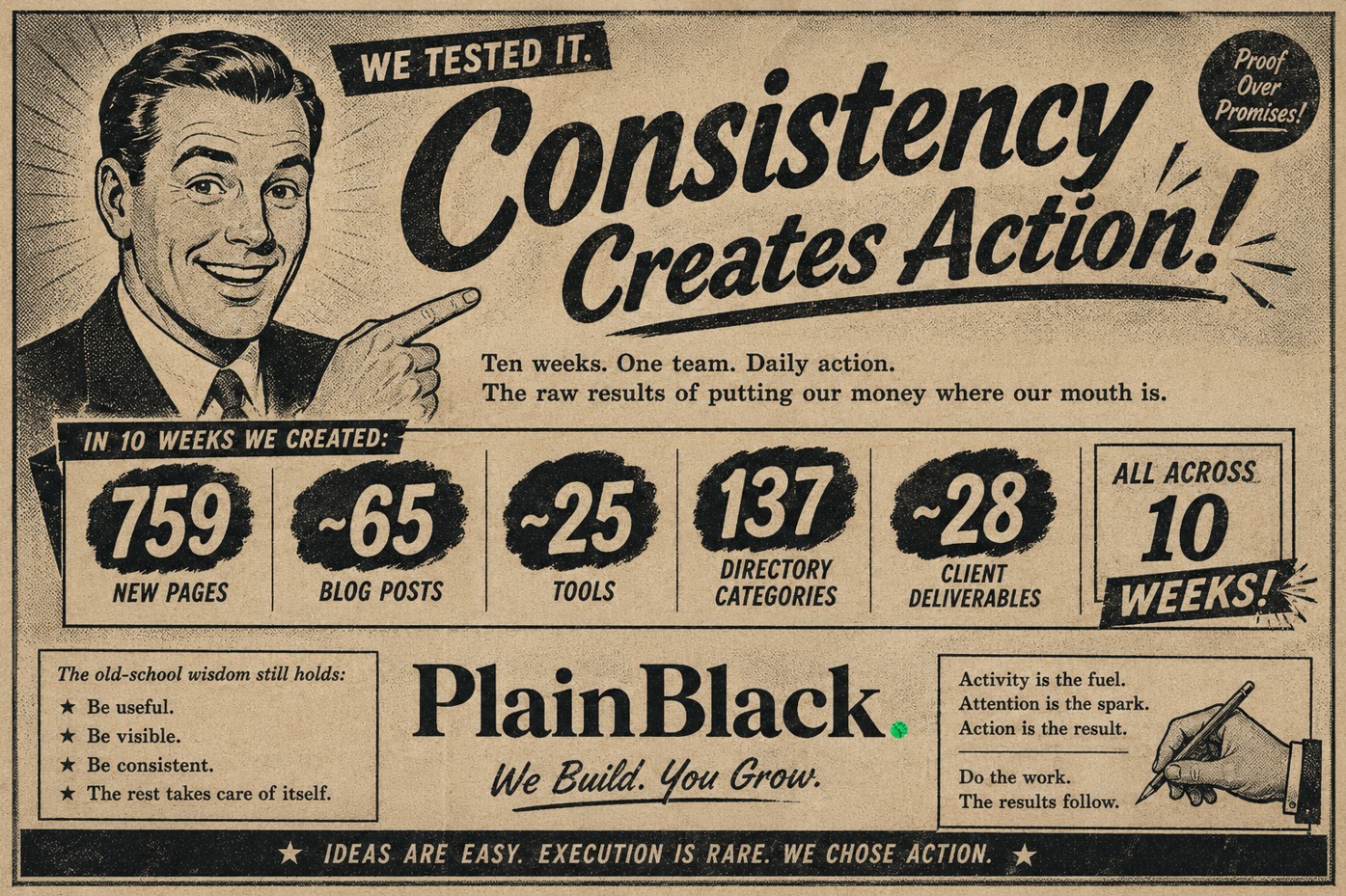
So we ran an experiment on ourselves. Over 10 weeks we published 759 new pages: around 65 blog posts, around 25 tools, 137 directory categories, and around 28 client deliverables.
We didn't do it to win an award for output. We did it to test a boring, slightly uncomfortable idea that a few smart people have been saying for decades: activity creates activity.
The thing nobody wants to hear: you have to show up first
There's a version of marketing strategy that small business owners love, because it lets them avoid the work. It goes like this: figure out the perfect plan, then act. Get the brand exactly right. Nail the messaging. Then, once everything is polished, start showing up.
The problem is the perfect plan never arrives, so the showing up never starts.
Vaynerchuk's whole argument, stripped of the noise, is that attention is the asset and you earn it by producing, publicly, far more than feels comfortable. Cardone's blunter version: most people fail because they massively underestimate how much action a result actually takes. Neither of them is selling magic. They're both saying the same plain thing. You can't optimise something that doesn't exist yet.
For 10 weeks we stopped planning the perfect thing and just built. A tool a week, give or take. Blog posts most days. Directory pages by the hundred. None of it was precious. Some of it was rough.
You cannot improve a page you haven't published, a tool nobody has used, or a post that's still a maybe in a notebook. Volume isn't the goal. It's the raw material that gives you something to fix.
Volume only works because it's attached to a point
Here's where the gym-bro version of this falls apart. Cranking out 759 of anything is worthless if it's 759 pieces of beige paste. You can publish every day and still be invisible, because nobody can tell what you actually do.
This is the part Ogilvy and Schwartz nailed long before any of us had a content calendar. Ogilvy's point was that the work has to sell something specific, not just decorate the brand. Schwartz's was sharper still: you don't manufacture demand, you channel the desire that's already sitting in the customer's head onto your specific offer. Volume without that is just a louder version of confusion.
So the directory pages weren't random. Each one answered a specific question a specific kind of business owner types in at night. The tools weren't there to look clever; each one did one useful job a stretched owner would otherwise pay someone to guard. The blog posts argued one point each instead of hedging across ten.
That's the distinction that matters for your business. A roofer who publishes 50 pages of welcome to our website, we pride ourselves on quality has produced 50 pages of nothing. A roofer who publishes 50 pages, each naming a real problem in a real suburb, has built 50 doors. Same effort. Completely different result.
What actually showed up
So did it work? The honest answer, in the build-log spirit: the activity bred more activity, exactly like the theory says it should.
The pages started talking to each other. A tool would point at a blog post, the post would point at a directory page, the directory page would surface a service. Conversations started that wouldn't have existed if we'd waited for the perfect plan. The around 28 client deliverables didn't come from a clever pitch deck. They came from being visibly, repeatedly in motion, so when someone needed the work, we were already on the screen.
We're not going to dress that up with a conversion percentage we didn't measure, because the moment a marketing post quotes a tidy stat it can't back, you stop believing it. What we'll say plainly: the inbox is no longer the quiet, refreshing-for-nothing problem it was. The kind of question coming in changed. The work found us because the work was findable.
The real lesson
You don't think your way out of being invisible. You publish your way out of it, one specific, useful page at a time, until the activity starts answering back.
You don't need 759 pages. You're not running an experiment on yourself. But you probably do need to stop waiting for the perfect version and ship the rough specific one, this week, that names a real thing a real customer wants. Then the next one. The plan gets clearer once there's something real to fix.