Most solar quote tools start the conversation with paperwork.
Name. Email. Phone. Address. Postcode. Power bill upload. "How big is your house?" dropdown. "What's your monthly electricity spend?" slider. Tick box for EV. Tick box for battery. Tick box for newsletter. Captcha. Submit.
Then nothing happens for two days. Then a sales call.
It's a lead repellent disguised as a lead magnet. Every field is a reason to bounce.
Today I built a different one.
It's for Genr8 Energy in Tasmania. Solar, batteries, EV charging, hot water, heat pumps. A working pitch, dressed up as a real product.
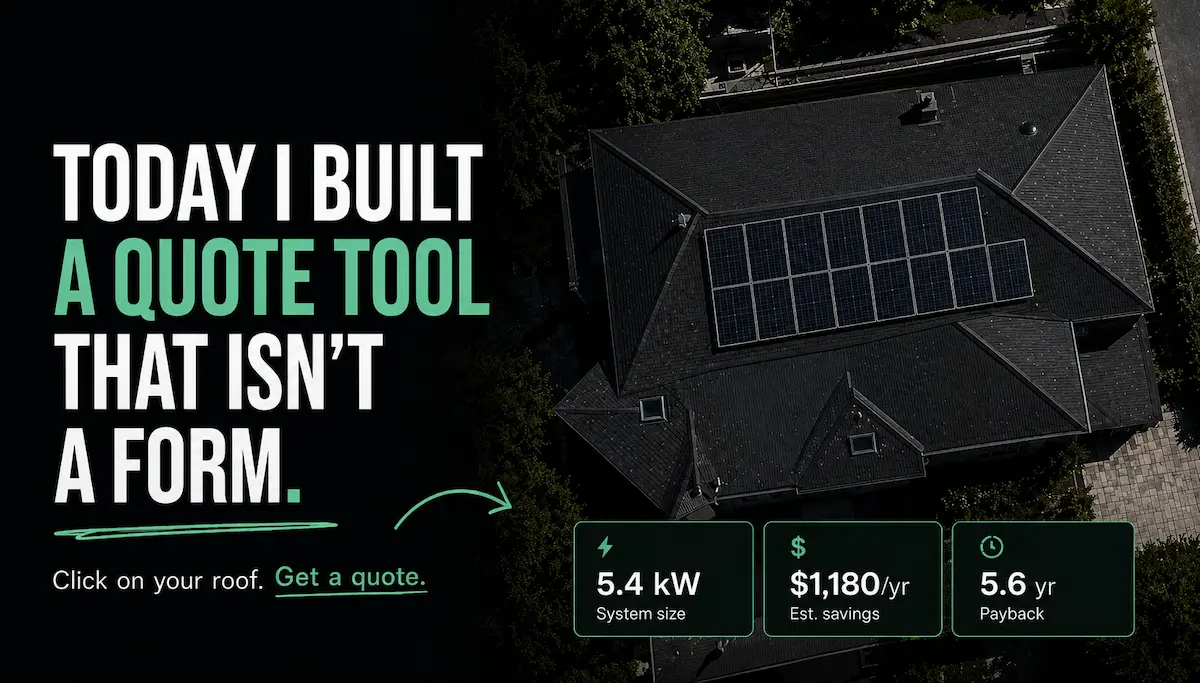
The whole interaction is poking at a satellite photo of your own house.
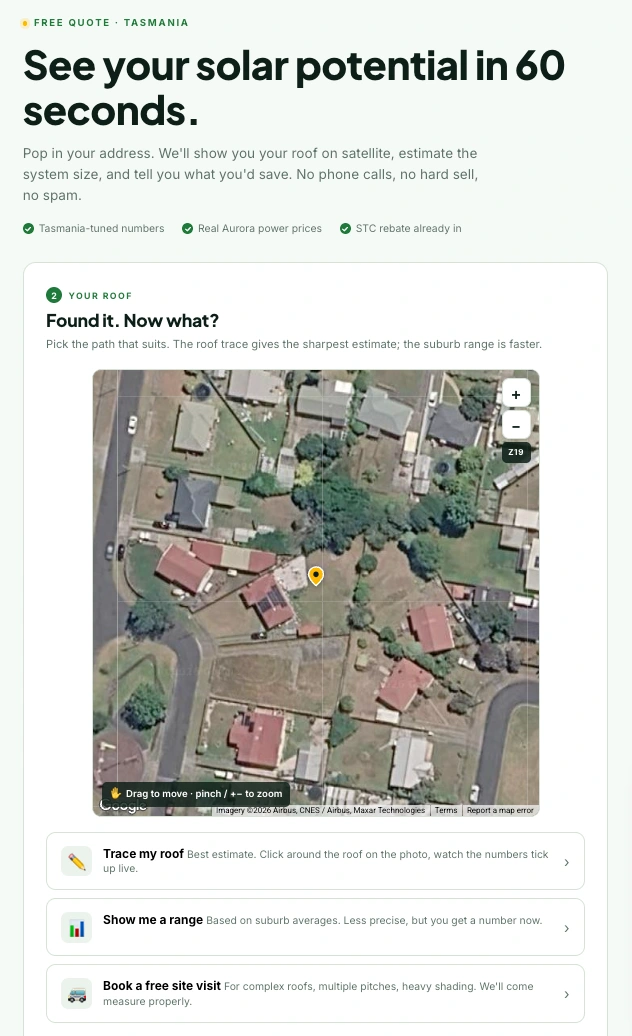
Type a Tasmanian address. Real Google Places autocomplete. The map slides to your roof.
If the pin lands a few metres off (Google geocoding does this regularly), you drag the map to fix it. Pinch to zoom in tighter, or use the buttons. Solar buyers spend ages on Google Maps before they ever talk to a salesperson, so this part should feel like Google Maps. So it does.
When the roof is centred, you trace the corners.
Panels animate inside the polygon as you close it off. A live meter under the photo ticks up: 47 m² traced. 5.4 kW system. Saves $1,180 a year. Pays back in 5.6 years.
Watching numbers move while you do something feels different from watching a loading spinner after you submit something. The first one is play. The second one is admin.
The numbers aren't decorative, they're real.
Tasmania irradiance. Aurora's actual 35.4782c/kWh peak rate, 16.6862c/kWh off-peak, 8.782c/kWh feed-in tariff STC rebate baked into the install cost. Self-consumption tuned to a normal Tassie household.
We're not making the numbers up. We're showing the actual maths and letting the buyer feel the shape of it before anyone has to talk on the phone.
Three exit doors. No dead ends.
Most quote tools have one outcome: submit the form. This one has three.
- Trace your roof for the sharpest estimate
- Show me a range for people who want a number now without tracing
- Book a free site visit for tree-shaded roofs and weird pitches the satellite can't read
Whichever door the buyer picks, the form at the bottom asks for the same three things: name, phone, email. That's it.
Now build your system.
Once the trace is locked in, the tool asks the natural follow-up question: what kind of system?
Three tier chips. Budget (Tier 2 panels + GoodWe string). Standard (REC or Winaico + Fronius). Premium (Aiko + Enphase or Sigenergy). Tap to switch and watch the install cost band shift.
Then optional upgrades. Battery 10 kWh. EV charger. Heating heat pump. Hot water heat pump. Tap any of them on or off. Install cost, annual savings, payback all recalculate live.
A line at the bottom reads back what's been spec'd:
Your build: Premium panels + battery + EV charger. Install $53,345 to $66,206. Savings $8,617/yr. Payback 6.9 years.
By the time the buyer reaches the form, they've spec'd their own system, played out the maths in their head, and pictured the install on their actual roof. The form isn't the price of admission anymore. It's the natural next step.
More leads aren't better leads. Genr8 only sees the warm ones.
Every form submission ships with a QuoteFit ranking out of 100.
- 🟢 Ready to go (60+) → call within two hours while it's warm
- 🟡 Shopping around (30 to 59) → send the written quote today, follow up in three days
- 🟠 Tyre-kicking (under 30) → drop into the nurture sequence, don't burn phone time on it
It scores the lead signal by signal: did the buyer trace, or take the shortcut? Did they customise the build, or stay on default? Did they leave a real message, or just the three required fields?
Genr8's sales team opens their inbox in the morning and gets a list already ranked for them. They call the green ones first. The orange ones drop into the email sequence. They stop wasting their best conversation energy on tyre-kickers, because the tool's already filtered.
We put a "what Genr8 sees" panel on the page so the value's visible during the demo, with a big DEMO ONLY tag so nobody confuses it for the customer-facing tool. The actual product hides this entirely.
Why this works for every service business that quotes.
Most service businesses give customers a wall of friction at the start. We've all trained ourselves to think of the quote form as a "lead magnet." It's the opposite. It's a lead repellent. Every field is a reason to bounce.
The trick isn't to remove the form. It's to replace the form with a thing the buyer actually wants to play with, and then put one tiny form at the end after they've already invested.
Roofers can do this. Painters. Landscapers. Pool installers. Concreters. Cleaners. Lawn-mowing rounds. Anyone whose price scales with a measurable physical thing. You give them a satellite photo. You let them trace. You show the maths in real time. You give them three exit doors. You score the warmth automatically.
It doesn't change what you charge or how you do the work. It changes how the buyer feels about you before the first conversation. They show up already half-sold.
The pattern, named.
We've now built two of these. Different industries. Same engine underneath. The rate table is the bit that swaps. The trace-and-tick toy is the same toy. The lead ranking is the same lead ranking.
It's shaping up to be a productised pattern any quote-driven trade can run in their own brand by the end of the week.
Day 8 of 30. The shape's getting clearer.