I've got a confession.
I own domains for businesses that don't exist.
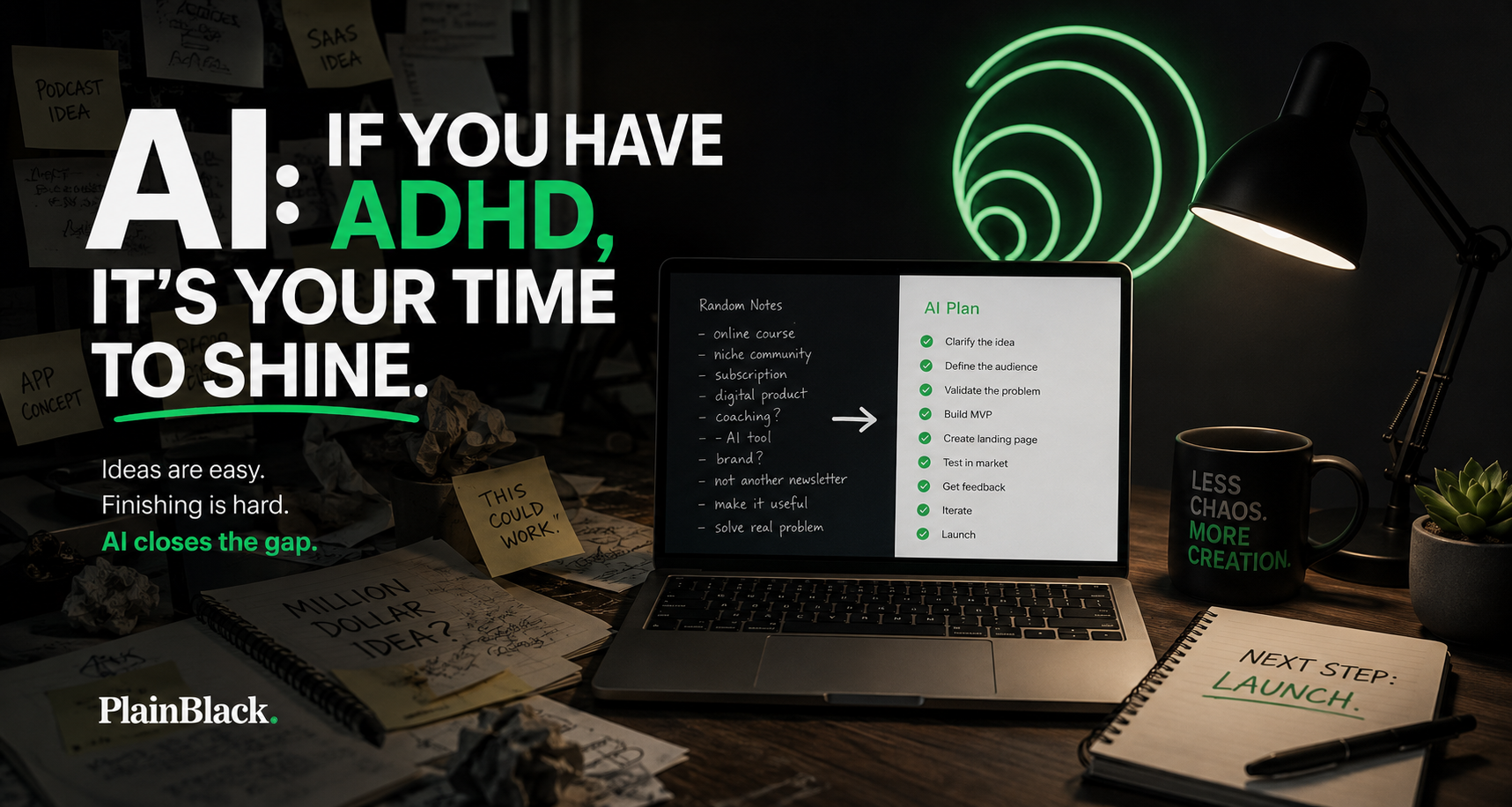
There are notebooks full of ideas that felt like billion-dollar companies at the time. Half-written blog posts. Product sketches. Voice notes recorded while driving because apparently my brain thinks a roundabout is the ideal place to reinvent an industry.
Every one of those ideas made perfect sense when they arrived.
Most never saw daylight.
If you have ADHD, there's a fair chance you're nodding along.
Not because you're lazy.
Not because you're incapable.
Because having an idea and turning it into a finished thing are two very different jobs.
For years, that gap has swallowed some genuinely brilliant ideas.
Now, for the first time in history, we have a tool that can help bridge it.
Not perfectly. Not magically.
But enough to change the rules.
ADHD was never an ideas shortage
One of the most frustrating misconceptions about ADHD is that it's simply being distracted.
Sometimes it is.
Sometimes it's the exact opposite.
You disappear down a rabbit hole researching one subject for six hours. You can see the finished product before anyone else knows there's even a problem worth solving. You connect dots that other people don't even realise belong on the same page.
Then comes the difficult part.
Planning.
Sequencing.
Remembering where you left off yesterday.
Breaking a massive idea into small enough pieces that your brain doesn't immediately wander off in search of something shinier.
The exciting bit isn't usually the problem.
It's the thousands of tiny administrative decisions between “this could work” and “this exists.”
If you're anything like me, you've probably mistaken unfinished projects for failed ideas.
They're rarely the same thing.
The world used to reward builders more than thinkers
For most of history, having a good idea wasn't enough.
You needed money.
You needed designers.
Developers.
Researchers.
Copywriters.
Marketing people.
Time.
Lots of time.
Even if you could see exactly what needed building, getting from the first sketch to something you could actually put in front of another human was expensive.
Every unfinished project carried a real cost.
Every experiment required commitment before you even knew whether the idea had legs.
That changes when AI enters the picture.
Not because AI is replacing people.
Because it dramatically reduces the cost of finding out whether your idea deserves to exist.
That's a massive shift.
AI isn't replacing your brain. It's helping organise the mess.
One of the biggest mistakes people make with AI is asking it to think for them.
Don't.
The interesting part still belongs to you.
Your experience.
Your instincts.
Your understanding of your customers.
Your ability to spot opportunities.
AI is surprisingly useful somewhere else entirely.
It takes the pile of disconnected thoughts sitting in your head and helps organise them into something you can actually work with.
Instead of staring at a blank document wondering where to begin, you can throw twenty messy notes at it and ask:
“What am I actually trying to build?”
Instead of spending an afternoon deciding what to do first:
“Break this into five steps I can finish today.”
Instead of wondering whether you're completely missing something obvious:
“Attack this idea. Tell me why nobody would buy it.”
Those aren't creative decisions.
They're organisational ones.
And organisation is often where the wheels come off.
This is how Jay and I build today
If you'd watched us work a couple of years ago, it looked very different.
I'd come up with an idea.
Jay would get excited.
We'd fill a whiteboard.
Then we'd spend days researching, documenting, writing, comparing software, planning workflows and building the first version.
Today, the conversation starts exactly the same way.
The difference is what happens next.
Within an hour we've usually asked AI to find weaknesses in the concept.
We've had it compare competitors we hadn't considered.
We've asked it to explain why customers might not care.
We've asked it to pretend to be the harshest critic we can imagine.
Sometimes it tears the whole thing apart.
Good.
I'd much rather discover an idea is rubbish after an afternoon than after six months and fifty grand.
Other times, it survives.
That's when Jay starts building.
The gap between an idea and a working prototype has become ridiculously short.
That isn't because AI is smarter than us.
It's because neither of us needs to spend hours doing work a machine can now do in minutes.
Our judgement has become more valuable because we're spending more time using it.
Here's how I'd attack an unfinished project today
Imagine you've got an idea that's been sitting in a folder since 2023.
Don't start by asking AI to build it.
Start by asking it to understand it.
Dump everything you've got into the conversation.
Messy notes.
Voice transcripts.
Half-finished paragraphs.
Random screenshots.
Customer emails.
Don't tidy anything first.
Then ask:
“Tell me what you think I'm trying to build. Who is it for? What problem does it solve? What information am I missing?”
Once you've got clarity, make the project smaller.
Not bigger.
Ask:
“Strip this back to the smallest version I could build and test this week.”
This is where most people get themselves into trouble.
They don't build Version One.
They build Version Everything.
Every feature.
Every page.
Every possibility.
Every future idea gets dragged into today's workload.
AI is remarkably good at saying:
“Ignore all that. Build this first.”
Then I get deliberately aggressive.
I'd ask:
“Pretend you're my ideal customer. Why would you ignore this?”
Followed by:
“Now pretend you're my biggest competitor. How would you beat me?”
Then:
“Assume this business fails in six months. Write the post-mortem.”
That process has killed plenty of my ideas.
I'm grateful every time.
The ones that survive deserve the effort.
Don't let AI become another unfinished project
There's a trap hiding in all this.
AI can generate ideas faster than your brain ever could.
That's fantastic.
It can also generate distractions faster than your brain ever could.
If you aren't careful, you'll finish every ChatGPT session feeling productive while producing absolutely nothing.
You'll have twelve business plans.
Seven book outlines.
Three podcasts.
A mobile app.
An online course.
Four logos.
A landing page.
Zero customers.
The point isn't to collect polished conversations with AI.
The point is to create things that leave the conversation.
A published page.
A prototype.
An email sent.
A customer interview.
A sale.
Something that now exists in the real world.
Because the market doesn't care how impressive your prompts were.
It only cares about the thing you put in front of it.
Maybe it's finally our turn
I don't buy into the whole “ADHD is a superpower” narrative.
For plenty of people, ADHD is frustrating, exhausting and expensive.
It has cost careers, relationships and opportunities.
Pretending otherwise doesn't help anyone.
What I do think is this.
For a very long time, people who naturally generated ideas were expected to become exceptional administrators just to give those ideas a chance.
Many never did.
Now we have tools that can shoulder some of that administrative load.
Not all of it.
You'll still need judgement.
You'll still need curiosity.
You'll still need to decide whether an idea deserves your time.
You'll still need the courage to put your work in front of another human being and risk hearing “No.”
AI can't do that bit for you.
But it can help you reach that moment faster than ever before.
If you've got a folder full of unfinished ideas, open one.
Not all of them.
Just one.
Dump the whole glorious mess into AI and ask it a simple question.
“What's the smallest version of this I can finish this week?”
Then go and finish the bastard.
Because there has never been a better time in history for people with ideas to discover whether those ideas are actually worth something.
And I reckon that's worth getting excited about.